

The SECURE Act and SECURE Act 2.0 significantly changed the post-death distribution rules for retirement accounts. These changes particularly affect situations where retirement benefits are payable to a trust.
Under current law, most non-spouse beneficiaries must withdraw inherited retirement accounts within ten years. Trusts named as beneficiaries must satisfy specific IRS requirements to avoid accelerated payout treatment. Small drafting differences can materially affect:
- Required minimum distribution timing
- Income tax treatment
- Whether a trust qualifies as a designated beneficiary
- Asset protection outcomes
Agile EP’s forms are designed with these structural realities in mind. The drafting approach focuses on flexibility and alignment with widely accepted expert guidance in retirement benefits planning.
Agile EP’s Dual Strategy
Agile EP addresses retirement-benefit planning through two complementary structural approaches:
- An optional retirement-benefits boilerplate that permits flexibility for post-death trustees
- With default conduit drafting built into QTIP-qualifying marital trusts
These approaches operate together but apply in different contexts.
Strategy One: Optional Retirement Benefits Flexibility Clause
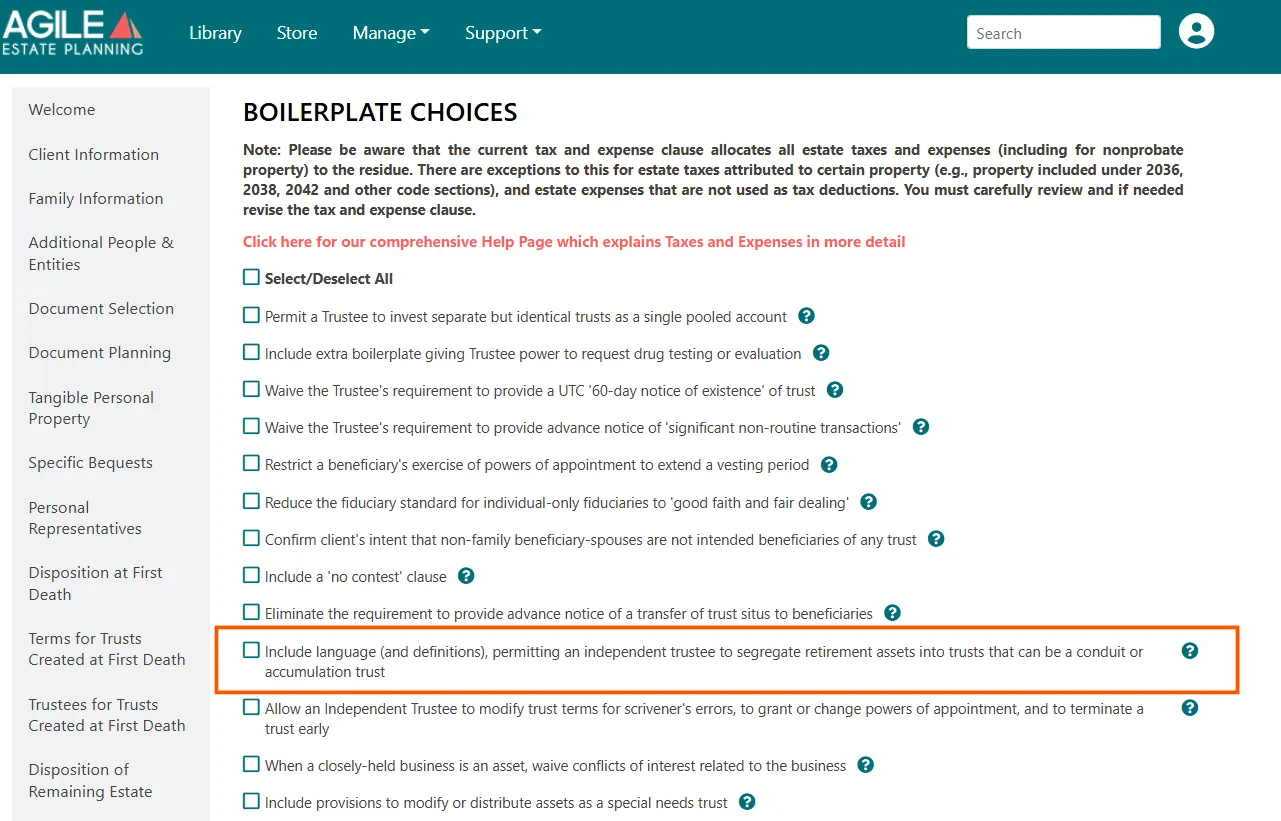
Agile EP includes an optional retirement-benefits provision that may be added through the Boilerplate Choices tab.
If selected, this provision allows an Independent Trustee to segregate retirement benefits payable to a trust and administer them under a structure chosen after death, based on then-current law and beneficiary circumstances.
If retirement benefits are payable to a trust created under the document:
- An Independent Trustee may create a separate trust solely for the Primary Beneficiary, and
- That separate trust may be structured as either:
- An Accumulation Trust, or
- A Conduit Trust
The election must be made in writing and delivered by the applicable IRS deadline (generally September 30 of the year following death, consistent with designated beneficiary determination rules).
This approach recognizes that:
- Tax regulations continue to evolve
- IRS guidance has changed since SECURE’s enactment
- Beneficiary circumstances may differ from expectations at signing
- The optimal balance between tax efficiency and asset protection may not be clear in advance
Rather than locking in a permanent conduit or accumulation structure at execution, the clause permits a qualified Independent Trustee to make that decision when the relevant facts are known.
Accumulation vs. Conduit Trust Structures
Conduit Trust
- All retirement distributions received by the trust must be passed directly to the beneficiary
- Generally more tax-efficient for the beneficiary
- Provides less asset protection once funds are distributed
Accumulation Trust
- Retirement distributions may remain in trust rather than being passed through
- Provides greater asset protection and administrative control
- May involve compressed trust income tax brackets if income is retained
Both structures remain viable under SECURE 2.0 when properly drafted, but involve trade-offs. The optional clause permits post-death selection between them.
Strategy Two: Default Conduit Drafting for QTIP Marital Trusts
When retirement accounts are payable to a QTIP-qualifying marital trust for a surviving spouse, additional coordination is required.
QTIP Requirements
- A QTIP trust must distribute all of its income to the surviving spouse annually.
- In retirement-benefit situations, “income” gets tricky, because the IRS distinguishes between trust accounting income and retirement account distributions.
Conduit Trust Requirements
- A conduit trust qualifies for favorable IRS “stretch” treatment if all distributions from the retirement account are paid directly to the spouse.
If these rules are not harmonized, a QTIP trust can inadvertently fail conduit treatment or accelerate required distributions, increasing income taxes from the retirement plan.
Agile EP’s marital deduction article is drafted so that the Trustee of the trust is required to withdraw the greater of
- The trust’s share of actual investment income from the retirement account, or
- The IRS-required minimum distribution.
Whatever is withdrawn is then paid directly to the surviving spouse. This structure is intended to align QTIP income requirements with conduit trust treatment for retirement benefits payable to a marital trust.
Special Needs Limitation
The retirement-benefits provisions described above are not designed to address planning for disabled or chronically ill beneficiaries. If a beneficiary may qualify as an Eligible Designated Beneficiary under SECURE Act rules, or if special needs planning is required to preserve public benefits, additional drafting revisions to the retirement provisions may be necessary. The default retirement clauses should not be relied upon to address those circumstances without consideration and possibly modification.
Why Agile EP Uses a Flexibility-Based Approach
SECURE Act 2.0 implementation has involved evolving regulations and delayed IRS guidance. Retirement-benefit trust qualification remains one of the most technical and frequently revised areas of estate planning.
Agile EP’s forms are structured to:
- Incorporate conduit-compliant marital drafting by default
- Permit post-death structural flexibility through an Independent Trustee
- Avoid locking in rigid pre-death elections where flexibility is appropriate
- Reflect commonly accepted expert commentary in retirement trust planning
The objective is adaptability within the framework of current law.
Additional Resources
Agile EP’s retirement-benefits drafting model is informed by widely recognized technical commentary, including:
- Natalie Choate: Estate Planning for Retirement Benefits Outline (2025)
- Natalie Choate: SECURE Act - Updates
- Ongoing seminars regarding RMD rules and trust qualification
Users seeking deeper technical analysis may consult those or other resources directly.
This article provides a general overview of how Agile EP’s forms address retirement benefits planning under SECURE Act and SECURE 2.0. It is not a substitute for reviewing the governing document language or obtaining tax-specific advice. The executed document and applicable law control in all circumstances.