

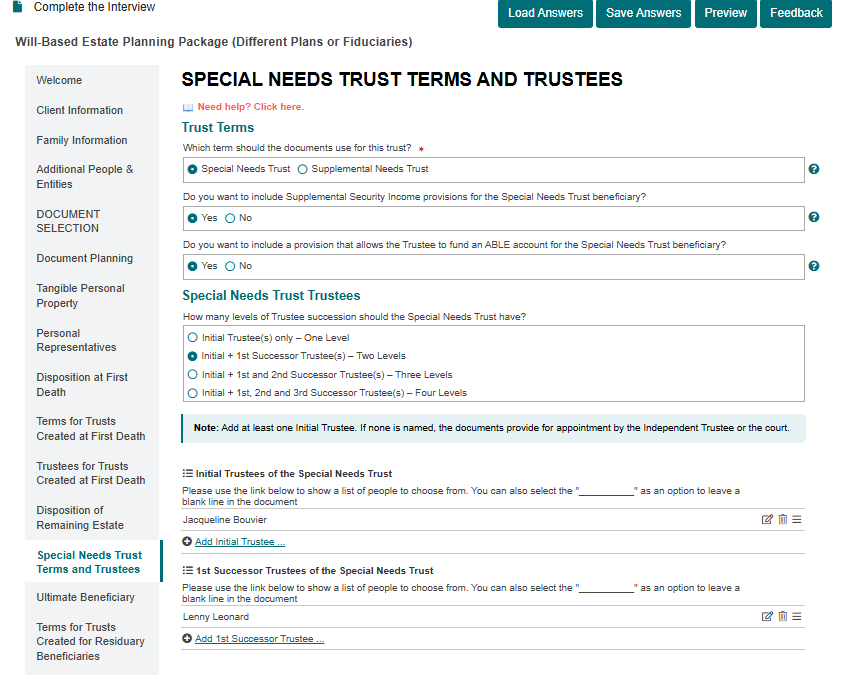
The Special Needs Trust Terms and Trustees tab configures the Special Needs Trust that holds one beneficiary’s share of the residue. It sets the name the documents use for the trust, whether the trust includes Supplemental Security Income provisions and authority to fund an ABLE account, and the Trustees of the trust.
These questions appear only when the drafter answers Yes to “Will any beneficiary’s share of the residue be held in a Special Needs Trust?” on the Document Planning tab. Where they appear depends on the Type of Residuary Devise. For every interview step that sets up a Special Needs Trust, see this article. For what every Special Needs Trust provides, see this article.
Where These Questions Appear
Below is where the Special Needs Trust questions are found for each Type of Residuary Devise.
Gift of the Entire Residue
The questions are on their own tab, Special Needs Trust Terms and Trustees, which appears after the Disposition of Remaining Estate tab. The Special Needs Trust beneficiary is selected on the Disposition of Remaining Estate tab.
Percentage Shares
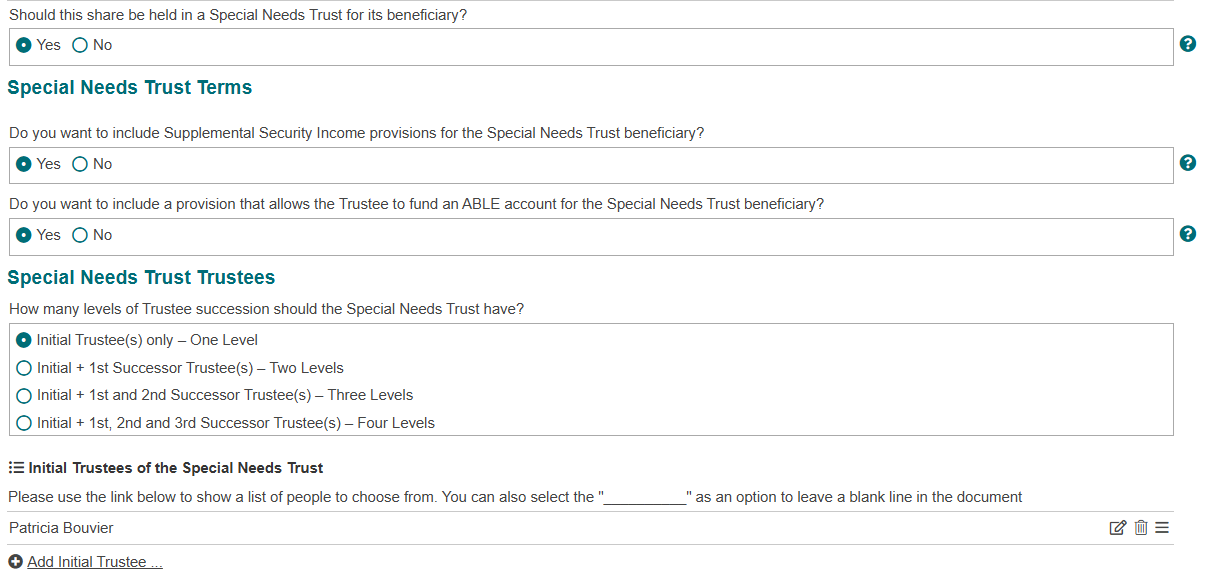
There is no separate tab. The questions appear on the Share Information screen for the beneficiary’s share, under the headings Special Needs Trust Terms and Special Needs Trust Trustees, after the drafter answers Yes to “Should this share be held in a Special Needs Trust for its beneficiary?” Only one share can be held in a Special Needs Trust.
Trust Terms
The questions and what each answer produces in the documents are the same in both locations.
Name of the Trust
“Which term should the documents use for this trust?” is required, with no default.
- Special Needs Trust: The documents name the trust the “[Beneficiary’s name] Special Needs Trust” and use that term throughout.
- Supplemental Needs Trust: The documents name the trust the “[Beneficiary’s name] Supplemental Needs Trust” and use that term throughout.
There is no legal difference between the two terms. The interview and the help center always say Special Needs Trust, whichever term the documents use.
Supplemental Security Income Provisions
The tab asks whether to include Supplemental Security Income provisions for the Special Needs Trust beneficiary.
- Yes: Names Supplemental Security Income among the benefits the trust is meant to preserve, and adds an example to the Trustee’s power to make distributions that affect eligibility: distributions treated as in-kind support and maintenance that reduce SSI. For SSI, in-kind support and maintenance is shelter that someone else provides or pays for (20 CFR § 416.1130).
- No: Leaves both out.
Every other provision of the trust is the same either way, including the Trustee’s power to make a distribution that reduces or ends the beneficiary’s benefits.
ABLE Account Provision
The tab asks whether to include a provision that allows the Trustee to fund an ABLE account for the Special Needs Trust beneficiary. An ABLE account is a tax-advantaged savings account for a person whose disability began before age 46.
- Yes: Adds a paragraph authorizing the Trustee to contribute trust funds to an ABLE account established for or by the beneficiary, naming the Oregon ABLE Savings Plan as an example.
- No: Leaves that paragraph out.
Special Needs Trust Trustees
This section names the Trustees of the Special Needs Trust and their successors.
Levels of Trustee Succession
“How many levels of Trustee succession should the Special Needs Trust have?” sets how many levels of Trustees the documents name:
- Initial Trustee(s) only (one level)
- Initial and 1st Successor Trustee(s) (two levels)
- Initial, 1st and 2nd Successor Trustee(s) (three levels)
- Initial, 1st, 2nd and 3rd Successor Trustee(s) (four levels)
A list for each level appears below, beginning with Initial Trustees of the Special Needs Trust. When a level names two or more Trustees, they serve as Co-Trustees, and if one cannot serve, the others continue.
If No Trustee Is Named
A Note on the tab says: “Add at least one Initial Trustee. If none is named, the documents provide for appointment by the Independent Trustee or the court.”