

Agile EP can create a Special Needs Trust to hold one beneficiary’s share of the residue, instead of distributing that share to the beneficiary. It is available in Will, Revocable Trust and Joint Revocable Trust plans, in Washington and Oregon. This article walks through the interview tabs that set it up. For what the trust provides and how it changes the rest of the plan, see this article.
Before You Start
A plan can have one Special Needs Trust, for one beneficiary, whether it gives the entire residue or divides it into percentage shares.
The Special Needs Trust is currently available for a beneficiary other than the client’s spouse or partner.
Step 1: Document Planning Tab
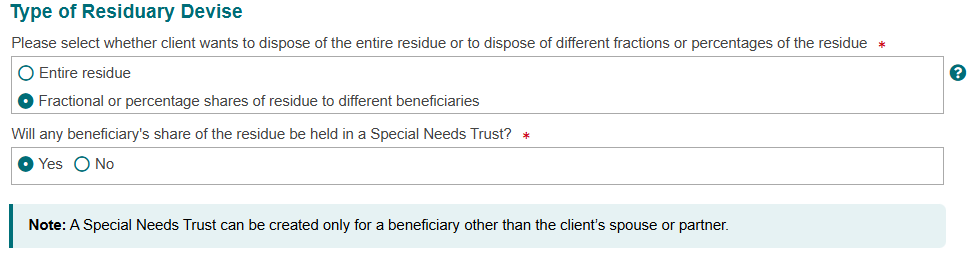
Under Type of Residuary Devise, the tab asks “Will any beneficiary’s share of the residue be held in a Special Needs Trust?”
- Yes: Brings up the Special Needs Trust questions on the Disposition of Remaining Estate tab. In a gift of the entire residue, it also adds the Special Needs Trust Terms and Trustees tab.
- No: Creates no Special Needs Trust.
For a married or committed couple, the tab also displays a Note: “A Special Needs Trust can be created only for a beneficiary other than the client’s spouse or partner.”
Step 2: Disposition of Remaining Estate Tab
How the Special Needs Trust beneficiary is selected depends on the Type of Residuary Devise. In the list of tabs, this tab is Disposition of Remaining Estate, or Disposition of Shares of Remaining Estate in a percentage-share plan. In a plan for a couple, the page heading reads Disposition at Second Death.
Gift of the Entire Residue
A Note at the top of the tab says: “The Special Needs Trust beneficiary is selected in the Special Needs Trust Beneficiary section further down this tab.”

When the residue passes to named individuals, the tab asks “Is the Special Needs Trust beneficiary the only residuary beneficiary?”
- Yes: The entire residue passes to the Trustee of the Special Needs Trust.
- No: Each residuary beneficiary is named as usual, including the Special Needs Trust beneficiary, whose share passes to the Special Needs Trust.
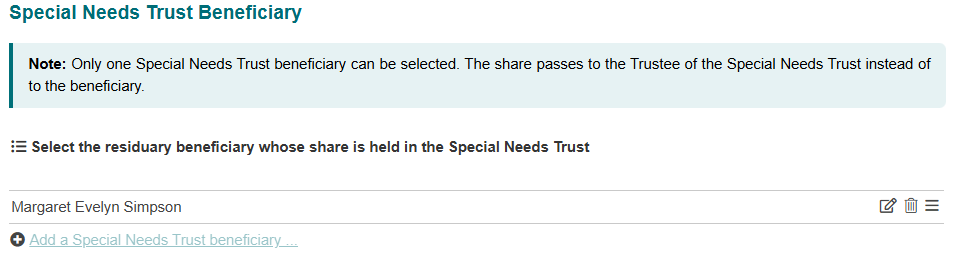
The Special Needs Trust Beneficiary section holds the picker “Select the residuary beneficiary whose share is held in the Special Needs Trust.” A Note above it says that only one Special Needs Trust beneficiary can be selected, and that the share passes to the Trustee of the Special Needs Trust instead of to the beneficiary.
When the residue passes to a class of people, such as the client’s grandchildren, the Special Needs Trust beneficiary is selected from that class in the same section.
The outright or trust question on this tab, and any trust terms that follow it, govern the other residuary beneficiaries only. When the Special Needs Trust beneficiary is the only residuary beneficiary, the outright or trust question does not appear.
In the documents, the beneficiary’s share passes to the Trustee of the Special Needs Trust. The beneficiary is left out of the other shares and any children’s trusts, and any portion that would later reach them goes to the Special Needs Trust instead.
Percentage Shares
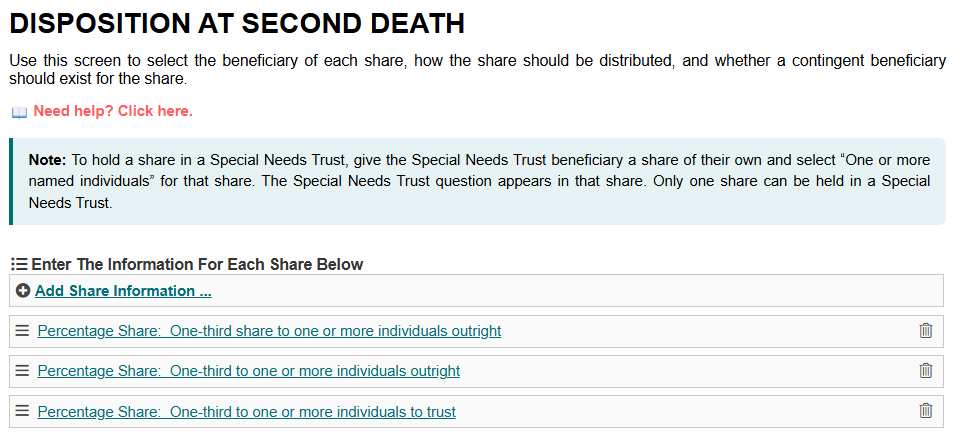
A Note at the top of the shares list says: “To hold a share in a Special Needs Trust, give the Special Needs Trust beneficiary a share of their own and select ‘One or more named individuals’ for that share. The Special Needs Trust question appears in that share. Only one share can be held in a Special Needs Trust.”
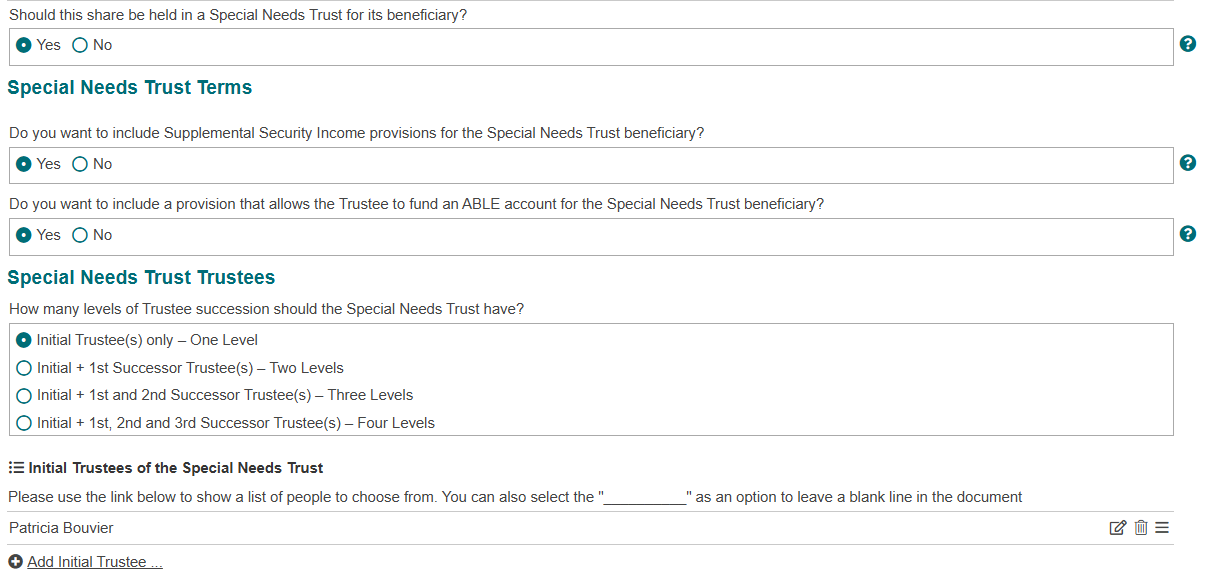
After the beneficiary of a share is selected, the share asks “Should this share be held in a Special Needs Trust for its beneficiary?” Nothing below the question appears until it is answered. Once one share answers Yes, the other shares no longer ask the question.
- Yes:The share passes to the Trustee of a Special Needs Trust for its beneficiary.
- A Special Needs Trust Terms section asks which term the documents use for the trust, and the Supplemental Security Income and ABLE account questions.
- A Special Needs Trust Trustees section asks the Trustee questions.
- The ordinary outright and trust questions stay hidden.
- No: The share shows the usual outright and trust questions.
A Special Needs Trust share can have only one beneficiary. If a second person is added to it, an Action Needed message appears: “A Special Needs Trust share can have only one beneficiary. Move the other beneficiaries to a share of their own.”
If the Special Needs Trust beneficiary also falls within another share, for example a share for the client’s children as a class, their portion of that share also passes to the Trustee of the Special Needs Trust.
Step 3: Special Needs Trust Terms and Trustees Tab
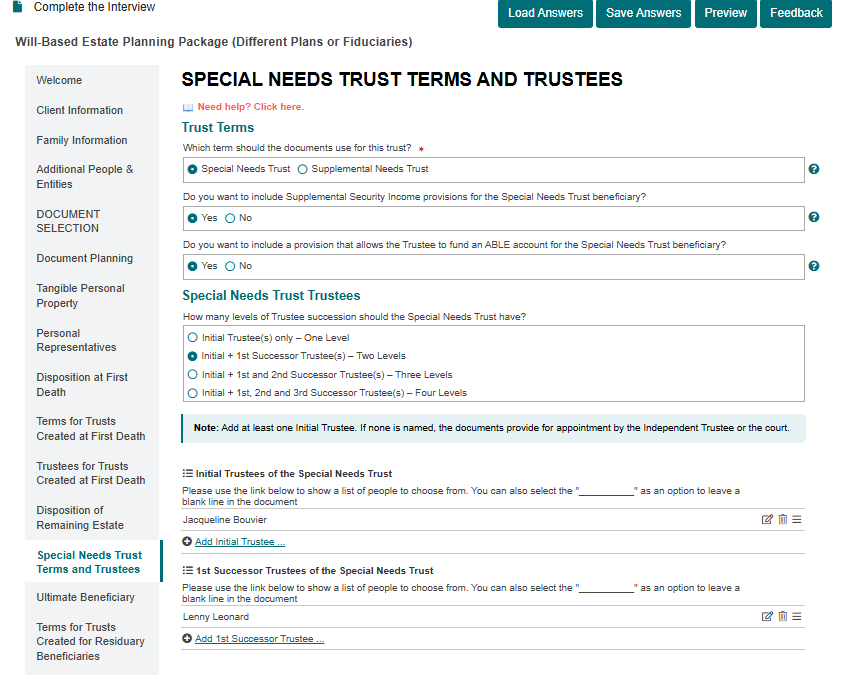
In a gift of the entire residue, the Special Needs Trust Terms and Trustees tab sets the name the documents use for the trust, whether the trust includes Supplemental Security Income provisions and authority to fund an ABLE account, and the Trustees of the trust. In a percentage-share plan, the same questions appear inside the Special Needs Trust share instead (see Step 2).
For each question and what each answer produces in the documents, see this article for Washington and this article for Oregon.
Notes on Other Tabs
With a Special Needs Trust in the plan, these tabs display Notes. None of them needs an answer.
Family Information
Each child and family member has a checkbox, “CHECK HERE if this child has a disability or special needs that might require qualification for government benefits.” Checking it labels the person as special needs in the interview lists and the Package Review, and displays a Note that the box does not create a Special Needs Trust. The trust is added on the Document Planning tab.
Tangible Personal Property
“Any tangible personal property, or proceeds from its sale, that would pass to the Special Needs Trust beneficiary is distributed to the Trustee of the Special Needs Trust instead. The Special Needs Trust beneficiary is selected on the Disposition of Remaining Estate tab.”
Ultimate Beneficiary
When the ultimate beneficiaries are anyone other than charities: “Any share that would pass to the Special Needs Trust beneficiary under this provision is distributed to the Trustee of the Special Needs Trust instead.”
Terms for Trusts Created for Residuary Beneficiaries
When the residue passes to trusts: “These terms apply to the residuary beneficiaries other than the Special Needs Trust beneficiary. The terms of the Special Needs Trust are set on the Special Needs Trust Terms and Trustees tab.”