

Once the court appoints the Personal Representative (PR) and issues Letters Testamentary, several statutory notice requirements arise. These notices inform interested parties and government agencies that probate has been opened and identify the appointed Personal Representative.
Unlike the Opening Probate Notices & Waivers tab, which determines whether advance notice or waivers are required, the Post-Appointment Package focuses on notices that must be sent after the PR has been appointed.
If you are looking for advance notice or waiver requirements required when opening probate, see this article.
Selecting Post-Appointment Documents
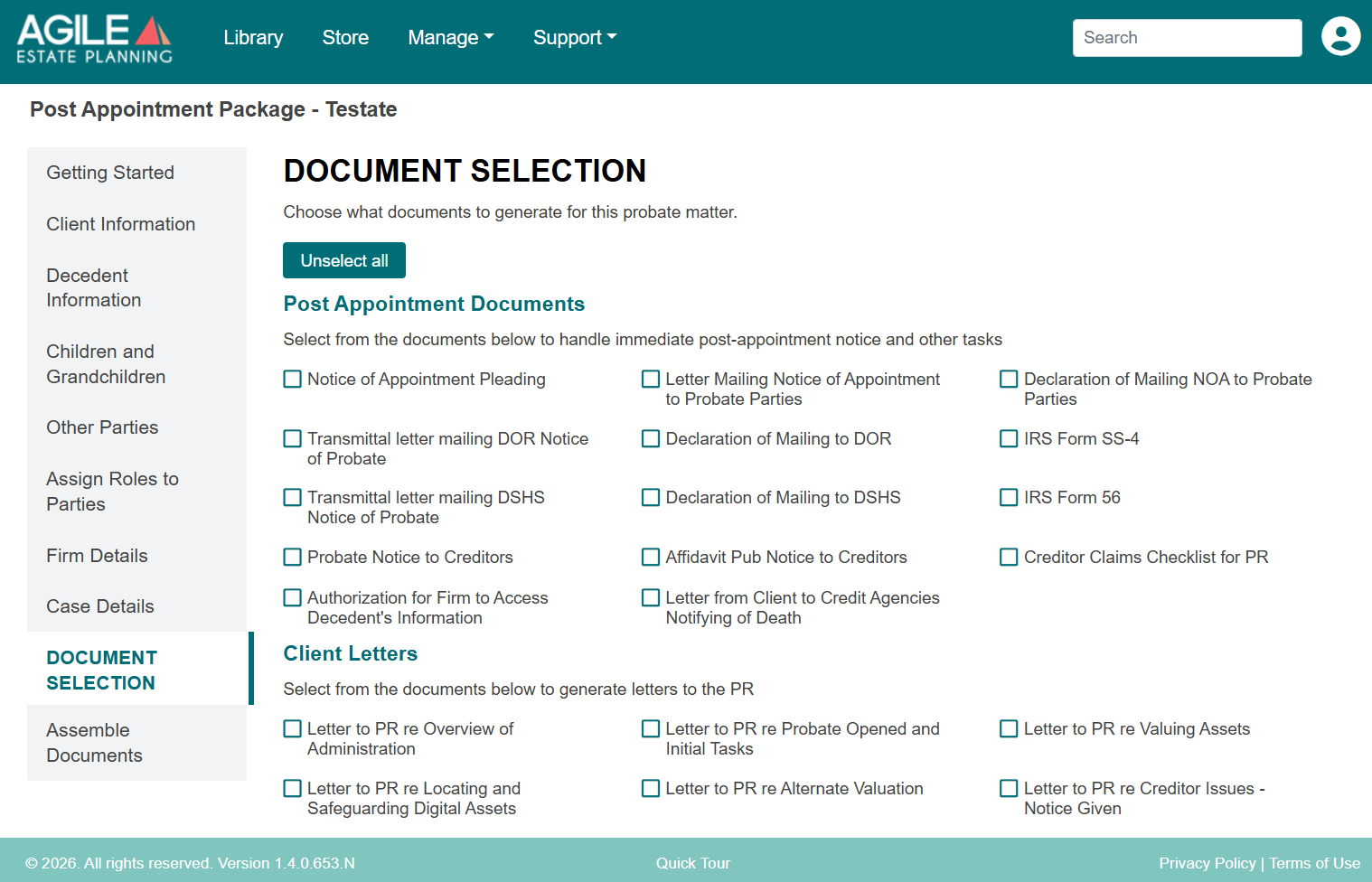
Within the Document Selection screen of the Post-Appointment Package, you must choose which post-appointment documents to generate.
These documents fall into three general categories:
Notice to probate parties
Notice to government agencies
Administrative notices and supporting documentation
You should select the documents appropriate for your probate matter based on the parties involved, agency reporting obligations, and the administration strategy for the estate.
Notice to Probate Parties
Washington law generally requires that interested parties be informed once probate has been opened and a Personal Representative has been appointed.
Agile EP allows you to generate:
Notice of Appointment Pleading
Letter Mailing Notice of Appointment to Probate Parties
Declaration of Mailing Notice of Appointment to Probate Parties
These documents notify heirs, beneficiaries, and other interested persons that:
Probate has been opened
The court has appointed a Personal Representative
The PR has authority to administer the estate
The Declaration of Mailing documents the mailing of these notices for the court file.
Notice to Government Agencies
In many probate matters, notice must also be sent to certain government agencies. Agile EP includes document options to notify:
Washington Department of Revenue (DOR)
Documents available:
Transmittal Letter Mailing DOR Notice of Probate
Declaration of Mailing to DOR
This notice alerts the Department of Revenue that probate has been opened and allows the agency to evaluate potential tax obligations.
Washington Department of Social and Health Services (DSHS)
Documents available:
Transmittal Letter Mailing DSHS Notice of Probate
Declaration of Mailing to DSHS
This notice allows DSHS to determine whether the decedent received benefits that may be subject to estate recovery.
Federal Tax and Identification Filings
The Post-Appointment Package also includes documents related to federal tax administration.
IRS Form SS-4
This form is used to obtain an Employer Identification Number (EIN) for the estate when required. An EIN is typically needed if the estate:
Maintains estate bank accounts
Generates income during administration
Files fiduciary income tax returns.
IRS Form 56
IRS Form 56 notifies the IRS that a fiduciary relationship exists and identifies the Personal Representative as the fiduciary responsible for the estate’s tax matters.
Probate Notice to Creditors
The Post-Appointment Package includes documents related to the probate creditor notice process, including:
Probate Notice to Creditors
Affidavit of Publication of Notice to Creditors
Creditor Claims Checklist for PR
Publishing a Notice to Creditors begins the statutory creditor claim process and can significantly shorten the period during which creditors may submit claims against the estate.
Because publishing creditor notice is a strategic decision, Agile EP also includes client letters in the Post-Appointment Package that explain the creditor process to the Personal Representative. These letters help the PR understand:
The purpose of publishing a Notice to Creditors
The advantages and disadvantages of publishing
The potential impact on creditor claim deadlines
After reviewing these materials with the PR client, you can decide whether the estate should publish notice to creditors.
If the decision is made to publish notice, the Post-Appointment Package allows you to prepare and initiate the publication process, including generating the notice and related documentation.
While the Post-Appointment Package allows you to start the creditor notice process, the ongoing administration of creditor matters — including reviewing claims, responding to claims, and resolving creditor issues — is handled in the Creditors Package within Agile EP.
For more information about managing creditor claims and related deadlines, see: Creditors Package.
Additional Administrative Documents
The Post-Appointment Package also allows you to generate administrative documents that help the PR manage estate administration. Examples include:
Authorization for Firm to Access Decedent's Information
Letter from Client to Credit Agencies Notifying of Death
Various client guidance letters to the Personal Representative
These documents help the PR begin the practical work of estate administration.