

A Deed Allocating Community Property is a probate administration tool used to formally confirm and record how community real property is allocated following the death of a spouse. In Washington, a community property state, real estate acquired during marriage is generally presumed to be community property.
When one spouse dies, the Personal Representative (PR) may need to formally allocate community property between the decedent's estate and the surviving spouse. The Deed Allocating Community Property allows the PR to allocate a real estate asset:
- 100% to the Estate; or
- 100% to the surviving spouse
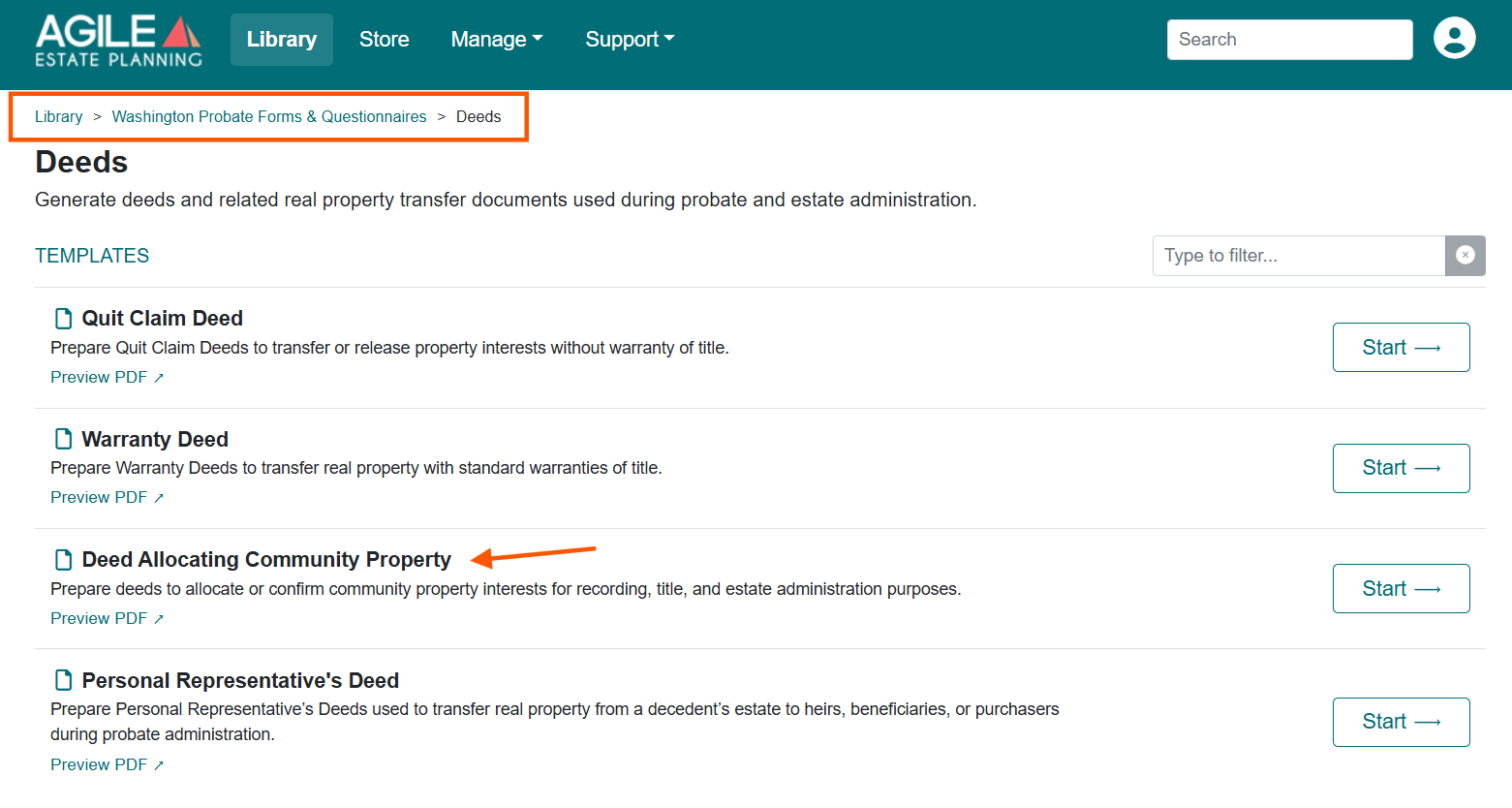
This deed memorializes that allocation in the real property records and clarifies legal title. To draft one, go to the Library > Deeds and select the Deed Allocating Community Property.
Statutory Authority for a Non-pro Rata Allocation
In Washington, each spouse owns an undivided one-half interest in community property under RCW 26.16.030. A nonpro rata allocation of community real estate during probate is supported by:
RCW 11.68.090(1)
This statute grants a Personal Representative with nonintervention powers broad authority to administer and settle the estate without court order. That authority includes the power to:
Manage estate assets
Determine distribution strategy
Distribute estate property in kind
Because the PR is empowered to settle and distribute the estate without court supervision, the PR may allocate specific assets to particular beneficiaries when doing so is consistent with the will and fiduciary duties.
RCW 11.98.070(15)
This statute grants fiduciaries the power to: make distributions in divided or undivided interests, allocate particular assets in proportionate or disproportionate shares, and adjust resulting differences in valuation. It allows a fiduciary to distribute specific assets to one beneficiary while distributing different assets to others, even if the distributions are not identical in form, so long as the overall shares are properly equalized.
Why This Deed May Be Necessary
Although Washington law governs how community property passes at death, title companies and county recorders require clear documentation of ownership before property can be sold, refinanced, or transferred.
Without a recorded allocation:
Title may appear ambiguous.
Ownership percentages may remain unclear.
A future transaction may be delayed.
Community property tax treatment could be questioned.
The Deed Allocating Community Property resolves these issues by clearly stating how the PR has allocated the subject real estate.
Use of a TEDRA Agreement to Confirm the Allocation
In some cases, beneficiaries may wish to formally approve or confirm the allocation. Under RCW 11.96A.220 (TEDRA), all interested parties may enter into a binding written agreement resolving matters involving the estate, including:
The characterization of property
The allocation or distribution of specific assets
Approval of the PR’s proposed nonpro rata distribution
A properly executed TEDRA agreement can:
Confirm that the nonpro rata allocation is approved by all beneficiaries
Waive objections
Reduce the risk of later dispute
Provide additional protection to the PR
When a nonpro rata allocation of community real property is made pursuant to such an agreement, the Deed Allocating Community Property reflects that the allocation is made consistent with the TEDRA agreement.
Example of a Nonpro Rata Allocation of Community Real Estate
Assume:
Husband and Wife owned a residence as community property.
Husband dies.
The residence is worth $1,000,000.
The remaining estate assets total $1,000,000.
The Will leaves the estate equally to Wife and two children.
The decedent’s one-half community interest in the residence (valued at $500,000) is part of the probate estate.
Rather than:
Selling the residence and dividing proceeds three ways, or
Distributing fractional interests in the residence to multiple beneficiaries,
the Personal Representative determines it is equitable and practical to allocate the residence entirely to the surviving spouse and distribute other estate assets to the children to equalize shares.
The final distribution might look like this:
Surviving spouse receives:
Her original one-half community interest in the residence ($500,000), plus
The decedent’s one-half community interest in the residence ($500,000).
Total to spouse: 100% ownership of the residence ($1,000,000 value).
Child A receives $500,000 of other estate assets.
Child B receives $500,000 of other estate assets.
Each beneficiary ultimately receives $500,000 from the decedent’s estate, but the assets are distributed nonpro rata. The spouse receives the residence in full, and the children receive other assets of equivalent value.
Because the residence was community property, a Deed Allocating Community Property is recorded to confirm that the decedent’s one-half interest has been allocated to the surviving spouse, vesting full title in her name.
Why the Deed Is Necessary in This Example
Even when beneficiaries agree to a nonpro rata allocation, the public record must clearly reflect ownership. The deed:
Documents how the decedent’s community interest was allocated
Clarifies that full title now vests in the surviving spouse (or other distributee)
Protects future transactions
Prevents title companies from requiring additional probate documentation
In short, the deed operationalizes the nonpro rata allocation in the land records.