

The Document Planning tab is a foundational configuration step in every Oregon estate planning drafting package. The selections made here directly control how the interview unfolds, ensuring that you are only asked questions necessary to produce the intended documents.
Unlike later tabs, which collect client-specific facts, the Document Planning tab establishes global drafting assumptions and planning decisions that apply throughout the interview and across all generated documents.
Purpose of the Document Planning Tab
This tab serves three core functions:
- Establish global terminology and drafting conventions used consistently in all documents
- Identify which planning features apply to the client’s plan
- Control which interview tabs appear or are suppressed
These early decisions streamline the interview and prevent the system from collecting information that will not be used in the final document set.
Why the Document Planning Tab Matters
Selections on the Document Planning tab actively reconfigure the interview. By making these decisions early:
- The interview remains focused and efficient
- Drafting time is reduced
- The risk of incomplete or irrelevant data entry is minimized
In short, the Document Planning tab ensures that the drafting experience aligns with the legal structure of the intended Oregon estate plan, so you see and answer only what is required to produce accurate, client-ready documents.
Terminology and Global Language Choices
At the top of the tab, you select how spouses are referenced throughout the documents (for example, “my husband or wife,” “my spouse,” or “my partner”).
This selection:
- Applies uniformly across all drafted documents
- Eliminates the need to repeat terminology choices later
- Ensures consistent, client-appropriate language in the final output
Community Property Option
Oregon is not a community property state, but community property rules may still apply to property if a client previously lived in a community property state and acquired property there.
If this option is selected, the Will, Revocable Trust, and Power of Attorney will include provisions addressing community property.
These provisions state that property contributed to the trust will be treated as the client’s interest in community property unless otherwise designated, and that any separate property will be held separately. The language helps preserve the legal character of property (community vs. separate) even after it is transferred to the trust.
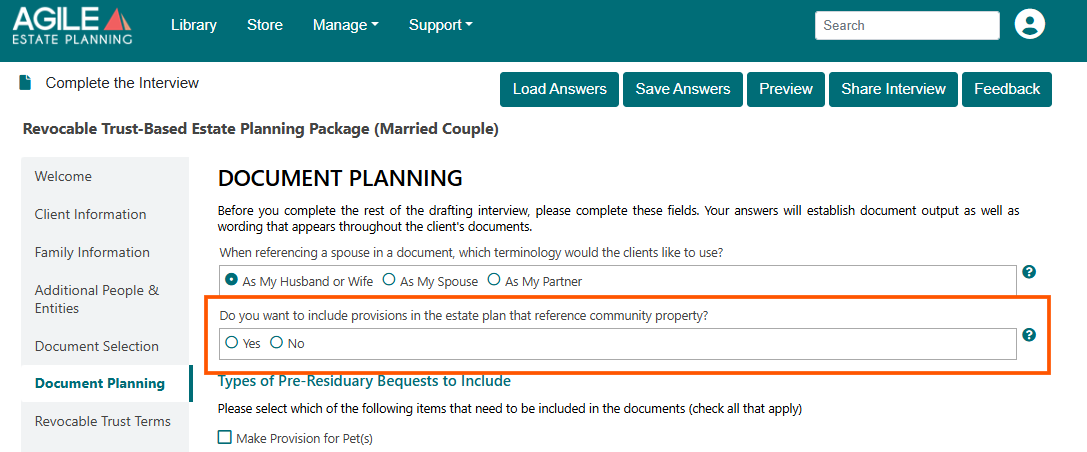
Types of Pre-Residuary Bequests to Include
This section of the tab allows you to specify whether the plan includes dispositive provisions that occur before the residuary estate is distributed.
Available options typically include:
- Provisions for pets
- Specific gifts of cash
- Specific gifts of real estate
- Specific gifts of closely held business interests
If an item is selected:
- Additional interview tabs related to that item will appear later
- The corresponding provisions will be included in the documents
If an item is not selected:
- All related questions are skipped entirely
- No unused or placeholder language appears in the final documents
Including Stepchildren in the Definition of “My Children”
This option appears when the Family Information tab reflects that at least one child is the child of only one client.
In blended-family matters, parentage entered in the Family Information tab determines whether a child is classified as a “joint child” or “a child for one client and a stepchild for the other client” for drafting purposes.
Selecting this option does not create a specific gift. It modifies how class-based language functions wherever it appears in the document package.
If parentage was entered incorrectly in the Family Information tab, this question will not appear and thus the definitional election may not reflect the client’s intent. Parentage should therefore be confirmed before finalizing this selection.
Type of Residuary Devise
This section of the tab defines how the remainder of the client’s estate (after expenses, taxes, and specific gifts) will be distributed. This choice has a significant impact on both the interview flow and the structure of the dispositive language.
You must select one of the following approaches.
Entire Residue
Selecting Entire residue means the client intends to dispose of the residuary estate as a single devise, even if multiple beneficiaries ultimately share in it.
Key characteristics
- The residue is treated as one unit
- Beneficiaries typically receive equal shares or are defined as a class
- No percentage or fractional allocations are required
Drafting example : “I give all of the rest, residue, and remainder of my estate to my children, in equal shares.”
This option is commonly used for:
- Equal distributions to children or descendants
- Simple or mirrored plans for married couples
- Plans where proportional allocation is unnecessary
Fractional or Percentage Shares of the Residue
Selecting Fractional or percentage shares of residue to different beneficiaries means the client intends to divide the residuary estate into specific portions allocated to identified beneficiaries.
Key characteristics
- Each beneficiary receives a defined share
- Shares may be expressed as percentages or fractions
- The total allocation must equal 100%
Drafting example
“I give the rest, residue, and remainder of my estate as follows:
Ten percent (10%) to [Person X];
Thirty percent (30%) to [Person Z]; and
Sixty percent (60%) to [Charity A].”
This option is commonly used for:
- Unequal distributions
- Mixed individual and charitable planning
- Plans requiring precise control over allocations
Special Needs Trust
Under Type of Residuary Devise, the tab asks “Will any beneficiary’s share of the residue be held in a Special Needs Trust?” Answering Yes brings up the Special Needs Trust questions on the Disposition of Remaining Estate tab and, in a gift of the entire residue, adds the Special Needs Trust Terms and Trustees tab. Answering No creates no Special Needs Trust.
For a married or committed couple, a Note says: “A Special Needs Trust can be created only for a beneficiary other than the client’s spouse or partner.”
See this article for every step that sets up a Special Needs Trust.
Spousal Disposition at First Death (Couples)
For married or partnered plans, the Document Planning tab also allows you to determine whether the surviving spouse is included as a beneficiary of the residuary estate at the first death.
This selection:
- Controls whether spousal disposition questions appear later
- Supports planning structures that bypass the spouse at first death
- Prevents unnecessary follow-up questions when the spouse is excluded