
The Community Property Agreement (CPA) is available in all married couple matters within Agile Estate Planning. It is not available for single clients or unmarried couples. The agreement may be drafted either as a standalone document or as part of a married couple estate planning package, including both Will-Based and Revocable Trust-based plans.
This is not the Status of Property Agreement
A Community Property Agreement converts the spouses’ property into community property. The Status of Property Agreement, found in the Irrevocable Trusts and Other Trusts folder of the Washington Estate Planning Library, does the reverse: it converts a community property asset into the separate property of each spouse, one-half each, so that it can be transferred to an irrevocable gift trust. See this article for details.
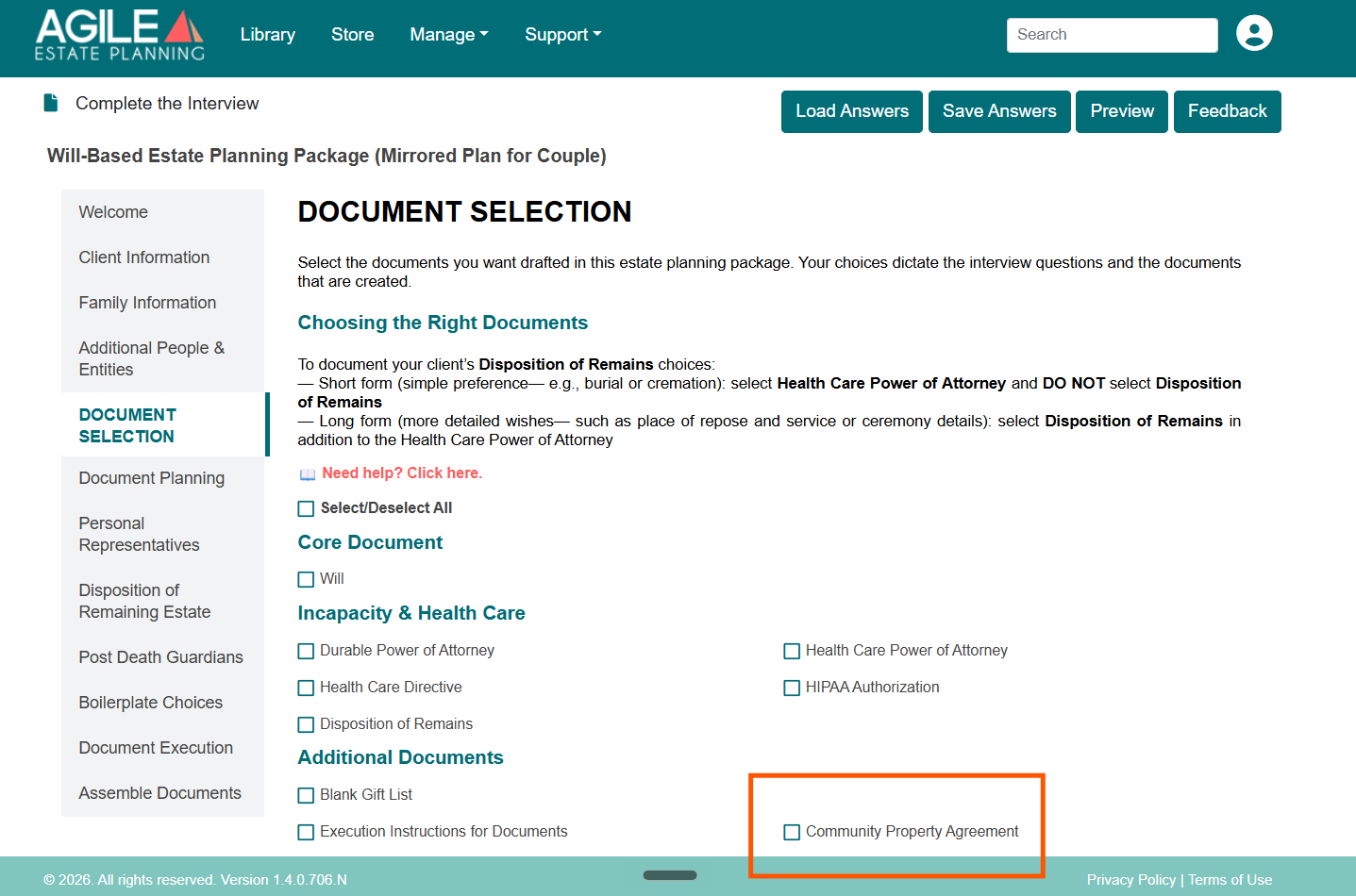
The CPA is selected on the Document Selection tab of the drafting interview. Once selected, you will complete the Community Property Agreement tab to tailor the structure to the clients’ goals.
Default Structure in Agile EP
When the Community Property Agreement box is checked, the system automatically generates a 2-prong CPA by default.
A 2-prong CPA focuses on converting property to community property during the spouses’ lifetimes:
Prong 1 converts the spouses’ property currently subject to the agreement into community property.
Prong 2 converts certain future acquisitions (property acquired after signing) into community property as well.
This structure addresses characterization of property now and going forward, without adding a survivorship-at-death provision.
Adding a Third Prong (Survivorship)
The user may elect to add a third prong, which provides that at the death of the first spouse, the covered community property vests in the surviving spouse.
If the third prong is selected, the system also includes a provision allowing the surviving spouse to disclaim all or part of the property passing under the survivorship provision. The disclaimer option applies specifically to property that would otherwise pass under the third prong.
This structure allows the couple to combine lifetime conversion with survivorship planning and built-in post-death flexibility.
Excluding Separate Property
Regardless of whether the agreement remains a 2-prong CPA or is expanded to include the third prong, you may always exclude identified separate property from the application of the agreement. This allows specific assets to retain their separate character even while other property is converted or made subject to survivorship.