

The Bond & Nonintervention Powers tab determines the level of financial protection and court supervision that will apply to the estate administration.
This tab addresses three related subjects:
- Bond requirements
- Nonintervention authority
- Solvency of the estate
Your selections here directly affect the Petition, the proposed Order, and the scope of authority granted to the Personal Representative.
Serving with Co-Personal Representatives?
A bond exemption under RCW 11.28.185 applies only to the Petitioner who qualifies for it. When only some of the Petitioners are exempt, the bond questions are divided into All Petitioners, The Client and Other Co-Personal Representatives sections. See this article for details.
Bond
A probate bond (also called a fiduciary bond) is a form of insurance intended to protect heirs and beneficiaries from losses caused by a Personal Representative’s misconduct or mismanagement.
Whether bond is required, and in what amount, is governed by Washington law (primarily RCW 11.28.185) and ultimately determined by the court.
Statutorily Exempt From Bond
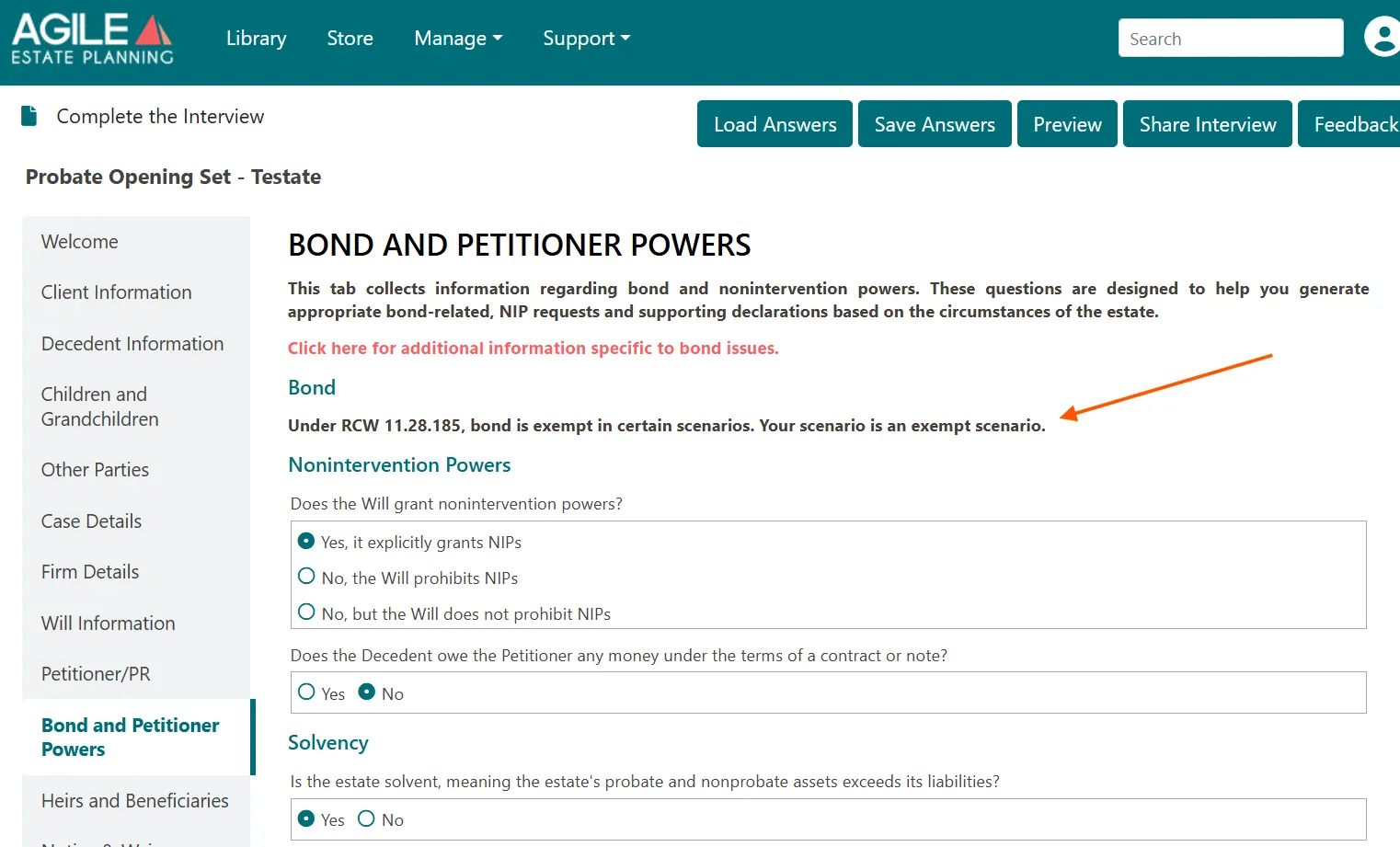
Under RCW 11.28.185, bond is not required in certain situations, including:
- The Decedent’s Will expressly waives bond;
- The Petitioner is the surviving spouse and sole beneficiary of the probate estate; or
- The Petitioner is a qualified bank or trust company authorized to act as Personal Representative (see RCW 11.36.010).
If the scenario qualifies for statutory exemption, bond options may not appear on the tab.
However, residency and other factors may affect exemption analysis. If exemption does not clearly apply, the system will prompt you to address bond.
If the Will Expressly Waives Bond
If the Will provides that the Personal Representative shall serve without bond:
- The court generally may not impose bond.
- The Petition will allege waiver pursuant to the Will.
- No request for bond is required.
Select Yes to reflect express waiver by the Will in the Petition.
If the Will Is Silent (but Does Not Prohibit Bond)
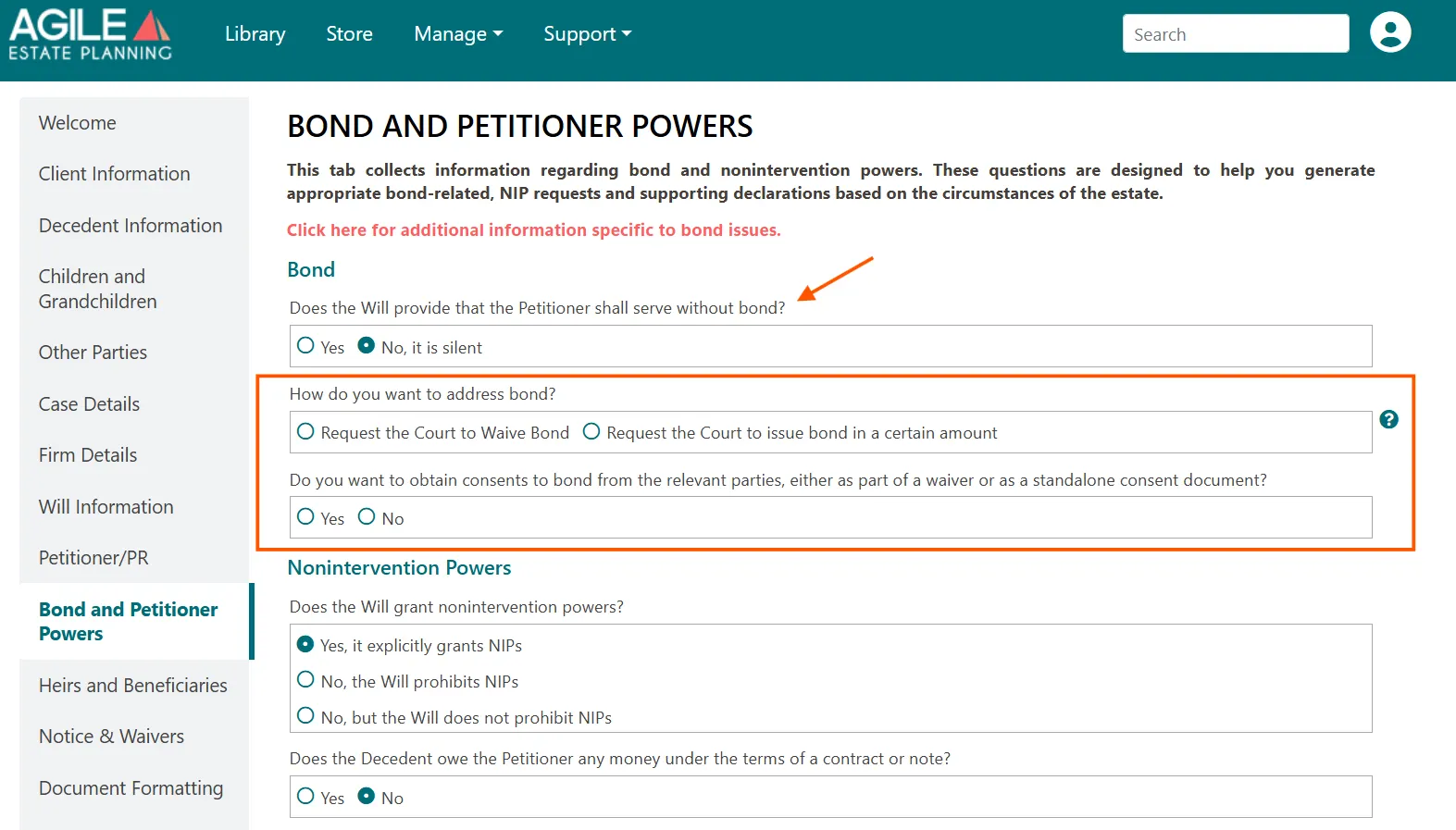
If the Will does not waive bond, the court retains discretion. You must then choose how to address bond in the Petition:
- Ask the Court to waive bond; or
- Ask the Court to set a bond amount.
The system will draft the Petition accordingly based on a series of additional questions.
Requesting Waiver of Bond
If requesting waiver, you will be prompted to provide a basis for the request.
The system allows you to:
- Enter a custom reason;
- Indicate that the Petitioner is an estate beneficiary;
- Indicate that bond cost is disproportionate to the estate size.
You may also elect to include an alternate bond amount in case the court declines to waive bond. This adds fallback language to avoid delay.
Calculating the Bond Amount
In Washington probate law, the amount of bond required for an estate is generally determined by the court’s discretion and guided by RCW 11.28.185.
Under RCW 11.28.185, unless bond is waived, the Personal Representative gives bond “in such amount and with such surety or sureties, as the court may direct.” Courts commonly set bond to cover the estate’s personal property and anticipated income, and not real property unless the Personal Representative will sell it or collect income from it, in which case expected sale proceeds or rent are considered.
The system does not calculate bond automatically; you must input the requested amount.
Consents Supporting Bond Requests
You may elect to obtain consents from heirs, beneficiaries, or special notice recipients supporting:
- Waiver of bond; or
- A specified bond amount.
If selected, the system will generate consent language or standalone consent documents.
If those parties are also signing waivers of advance notice, consent regarding bond may be incorporated into those same documents.
Bond consents are distinct from advance notice waivers and do not eliminate other notice obligations.
Nonintervention Powers
Nonintervention powers allow a Personal Representative to administer the estate without ongoing court supervision after appointment. When granted, the PR may act independently, without returning to court for routine administrative actions.
Agile Estate Planning’s probate opening packages are structured for administration with nonintervention authority.

The system does not support drafting a fully supervised probate administration in which nonintervention powers are not requested or are affirmatively denied.
Whether nonintervention authority is requested, and whether it can be granted, depends on two primary factors:
- The language of the Will; and
- The solvency of the estate.
This tab captures both and controls how the Petition and proposed Order are drafted.
Effect of the Will
The Will determines the framework for nonintervention authority.
- If the Will explicitly grants nonintervention powers, the Petition will allege that authority and request confirmation of independent administration in the Order.
- If the Will prohibits nonintervention powers, the system will not request independent administration, and the estate will proceed under court supervision.
- If the Will is silent, nonintervention authority may still be requested if statutory requirements are satisfied. In that situation, the estate’s solvency becomes critical.
Your selection ensures that the Petition accurately reflects the Will’s treatment of nonintervention authority.
Solvency
Nonintervention powers generally require that the estate be solvent, meaning the estate’s assets exceed its liabilities. The tab asks whether probate and nonprobate assets exceed known debts.
Your response affects:
- Whether nonintervention authority is requested;
- Whether solvency allegations are included in the Petition;
- Whether approximate asset values and liabilities are recited to support the request.
If the estate is insolvent, nonintervention authority is typically not appropriate.
Because the court relies on these representations, confirm the estate’s financial posture before completing this section.
Disclosure of Debt Owed to the Petitioner
If the Decedent owed money to the Petitioner under a contract or note, that relationship must be disclosed. This may affect:
- The solvency analysis;
- The Petition’s factual allegations;
- The court’s evaluation of independent administration.
The system incorporates disclosure language based on your response.
NIPs & Minor or Incapacitated Interested Persons
Under RCW 11.76.080, if an interested person is:
- A minor; or
- An incapacitated person who does not have a legally appointed guardian, conservator, or other representative under RCW 11.130,
the court must appoint a Guardian ad Litem (GAL) to evaluate whether nonintervention powers should be granted.
This requirement exists because granting nonintervention authority removes ongoing court supervision of the estate. Before allowing independent administration, the court must ensure that vulnerable interested persons are adequately protected.
A limited statutory exception may apply in certain circumstances involving minors who are children of the Decedent and the surviving spouse, where the surviving spouse is the sole beneficiary of the estate. The statute controls the scope of that exception.