

A Health Care Power of Attorney (HCPOA) allows a client to appoint someone they trust to make medical decisions if they are unable to communicate informed consent. Within the Agile EP estate planning packages, the Health Care Power of Attorney and the Health Care Directive work together to address the full range of health care and end-of-life planning.
Here is how the Agile EP documents divide responsibility:
The Health Care Directive (HCD) governs a narrow but critical category of decisions:
Life-sustaining treatment
Comfort and pain management measures
Organ donation
Under Washington law, the Directive applies only if the client is in a terminal condition or a persistent vegetative state. It answers the specific question of whether life-sustaining treatment should be continued or withdrawn in those defined circumstances.
The Health Care Power of Attorney, by contrast, grants broad authority to the named agent and governs virtually all other medical decisions during incapacity, including:
Routine and non-routine treatment
Surgical procedures
Long-term care placement
Psychiatric or behavioral health treatment (if selected)
Access to medical records
General care coordination
In addition, the Agile EP HCPOA may include basic post-death instructions (such as burial or cremation preferences) unless a separate Disposition of Remains document is selected. The separate Disposition of Remains document includes greater details about post-death matters.
This article explains how to draft the Health Care Power of Attorney within the Agile EP system. For related guidance, see:
Drafting as Part of a Plan or as a Standalone Document
The Health Care Power of Attorney is typically drafted as part of a Will-based or Trust-based estate planning package.
However, it may also be drafted as a standalone document.
To prepare the HCPOA by itself:
Go to the Document Selection tab.
Select Health Care Power of Attorney.
Leave the other estate planning documents unselected.
As long as the required People tabs have been completed (Client Information, Family Information, and any necessary Additional People), the system will generate the HCPOA without requiring the rest of the estate planning package.
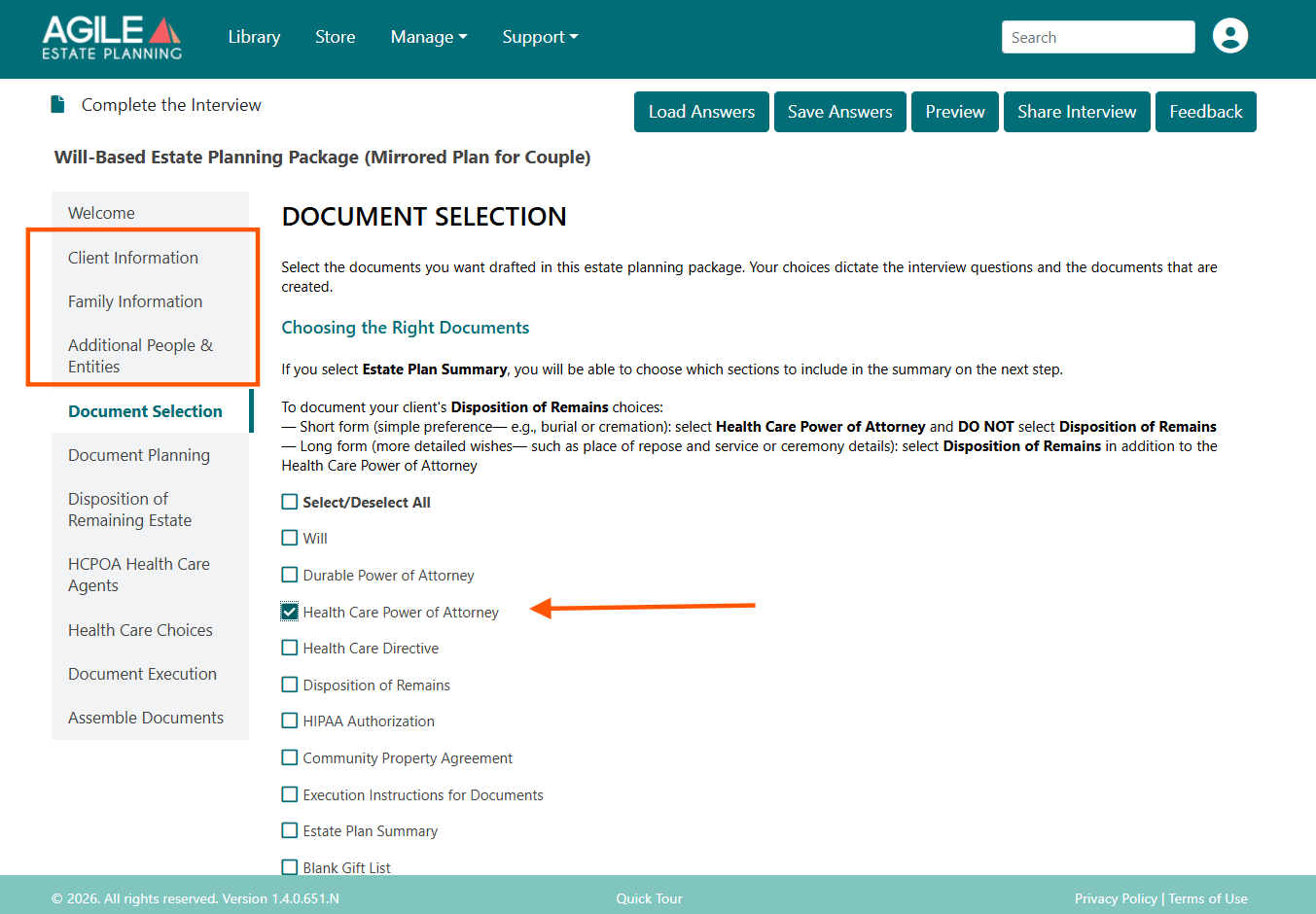
Once those sections are finished, you may proceed directly to the Health Care tabs to complete the HCPOA.
Complete the Health Care Choices Tab (HCPOA Sections)
This tab determines how the agent’s authority is structured in the final document. Each selection directly affects the scope and flexibility of the language included in the Health Care Power of Attorney.
Authority to Make Health Care Decisions for Minor Children
If the client has minor children, the Health Care Choices tab asks whether the named Health Care Agent should also have authority to make health care decisions for the children. This authority applies only if both parents are unable to communicate decisions or exercise custody. It does not override the rights of a capable parent.
The options include:
- Authorize the same Health Care Agent
If selected, the HCPOA will include language granting the named agent authority to consent to or refuse medical treatment for the client’s minor children in those limited circumstances. - Name a different Agent for the child
If selected, the document will appoint a separate person solely for purposes of making health care decisions for the minor children if both parents are unable to act.
This selection allows the client to decide whether continuity or separation of decision-making is most appropriate for their family structure.
Successor Appointment Authority
You must decide whether a named agent may appoint a successor if no other named agents are available.
- If you allow successor appointment, the document will include language authorizing an acting agent to designate a replacement agent if all named agents are unable or unwilling to serve. This adds flexibility and helps avoid the need for court involvement if circumstances change.
- If you do not allow this authority, only the individuals named in the document may serve. No additional successor may be appointed.
Authority to Appoint Co-Agents
You must determine whether a named agent may appoint an additional co-agent.
- If selected, the HCPOA will include language allowing an acting agent to add a co-agent to assist with decision-making. This can be useful if support is needed due to geography, health, or complexity of care.
- If not selected, authority remains limited to the individuals expressly named in the document. This can be exactly what the client wants.
Psychiatric / Behavioral Health Authority
Washington law requires that a Health Care Power of Attorney specifically authorize an agent to consent to psychiatric hospitalization or other mental or behavioral health treatment. General health care authority alone is not sufficient.
- If selected, the HCPOA will include express language authorizing the agent to consent to or refuse psychiatric and behavioral health treatment on the client’s behalf, including inpatient or outpatient care as permitted by law.
- If not selected, the HCPOA will not address psychiatric/behavioral health at all.
If the client has a history of mental health treatment or anticipates future psychiatric care, it may be appropriate to prepare a separate Mental Health Directive, which is distinct from a standard Health Care Directive. A Mental Health Directive allows more detailed instruction and may require coordination with the client’s physician.
End-of-Life Care Location Preference
The client may express a preference regarding where they would like to receive end-of-life care. If a location is selected (for example, at home), the HCPOA will include a statement of preference guiding the agent. This language is advisory and does not override medical feasibility, but it is intended to provide meaningful direction to the health care agent. If the client prefers flexibility, the document may instead state that the decision is left to the agent’s discretion.
Post-Death Preferences Within the HCPOA
If a separate Disposition of Remains document is not selected, the Health Care Choices tab will include a section asking how the client wishes their remains to be handled.
Selecting an option here adds a brief sentence of preference to the HCPOA (for example, burial, cremation, or a green alternative). It does not create a separate statutory Disposition of Remains document and does not include detailed placement or memorial instructions. The health care agent will have authority to carry out these general wishes.
If the client wants detailed cemetery instructions, funeral planning language, military honors, or custom provisions, you should instead select Disposition of Remains in Document Selection. In that case, the HCPOA will defer post-death authority to the separate document.