

Durable General Power of Attorney (DPOA) allows a client to appoint someone they trust to manage financial and legal matters if the client becomes unable to act for themselves. Under Washington law, the document is governed by the Washington Uniform Power of Attorney Act, Chapter 11.125 RCW.
Within the Agile EP system, the Durable General Power of Attorney is designed to address financial decision-making during incapacity or other circumstances where the client cannot personally manage their affairs.
The DPOA determines:
- Who will act as the client’s agent (attorney-in-fact)
- When the agent may act
- What authority the agent will have
This article explains how to draft the Durable General Power of Attorney within the Agile EP system.
Drafting as Part of a Plan or as a Standalone Document
The Durable General Power of Attorney is typically drafted as part of a Will-based or Trust-based estate planning package. However, it may also be drafted as a standalone document.
To prepare the DPOA by itself:
- Go to the Document Selection tab.
- Select Durable General Power of Attorney.
- Leave the other estate planning documents unselected.
As long as the required “people tabs” have been completed (Client Information, Family Information, and any necessary Additional People), the system will generate the DPOA without requiring the rest of the estate planning package. Once those sections are finished, you may proceed to the DPOA tabs in the drafting interview to complete the document.
Complete the DPOA Financial Agents Tab
This tab designates the client’s agents (attorneys-in-fact), the individuals who will have authority to act under the Durable General Power of Attorney.
- For mirrored documents (married or unmarried couples), complete this tab once. The answers automatically populate both clients’ documents.
- For single clients or non-mirrored couples, complete the tab separately for each person.
Agents are organized by levels of succession. At each level, you may name one agent or multiple co-agents who serve at the same priority level.
You may name up to four levels of agents, beginning with the initial agent and followed by successor levels.
For a detailed explanation of how fiduciary levels and co-agents operate in the system, see this article.
Complete the DPOA Agent Powers Tab
This tab allows you to design how and when the agent’s authority operates and what powers the agent will have when acting.
Effectiveness of the Power of Attorney
The first decision determines when the agent’s authority becomes effective.
The available options include:
- Effective Immediately
The agent may act as soon as the document is executed. - Effective Upon Incapacity
The agent’s authority begins only if the client becomes incapacitated. - Hybrid Option
The power is effective immediately for a spouse but becomes effective upon incapacity for all other agents.
Regardless of the option selected, agents are designated as HIPAA personal representatives for the limited purpose of determining incapacity.
Determining Incapacity
Incapacity of the principal is determined pursuant to RCW 11.125.090(3), typically relying on the principal’s attending physician or psychologist.
Under RCW 11.125.020(5), “incapacity” means inability of an individual to manage property, business, personal, or health care affairs because the individual:
- Has an impairment in the ability to receive and evaluate information or make or communicate decisions even with the use of technological assistance; or
- Is an absentee under Chapter 11.80 RCW or is outside the United States and unable to return.
Co-Agent Design Decisions
If multiple agents are named, you must determine how they will operate. These selections determine how flexible the agent structure will be if circumstances change.
The tab asks you to decide:
- Whether co-agents must act jointly or may act independently
- Whether an acting agent may nominate successors if no named successor is available
- Whether an acting agent may appoint an additional co-agent
Under RCW 11.125.110, co-agents may delegate authority among themselves, and the statutory liability framework applies to delegated acts.
Note: An Agent’s Certification template is available to draft to prove an agent’s authority in the Miscellaneous Documents folder in the Library.
Determining the Agents’ Powers
The Agent’s authority is divided into two sections within the tab:
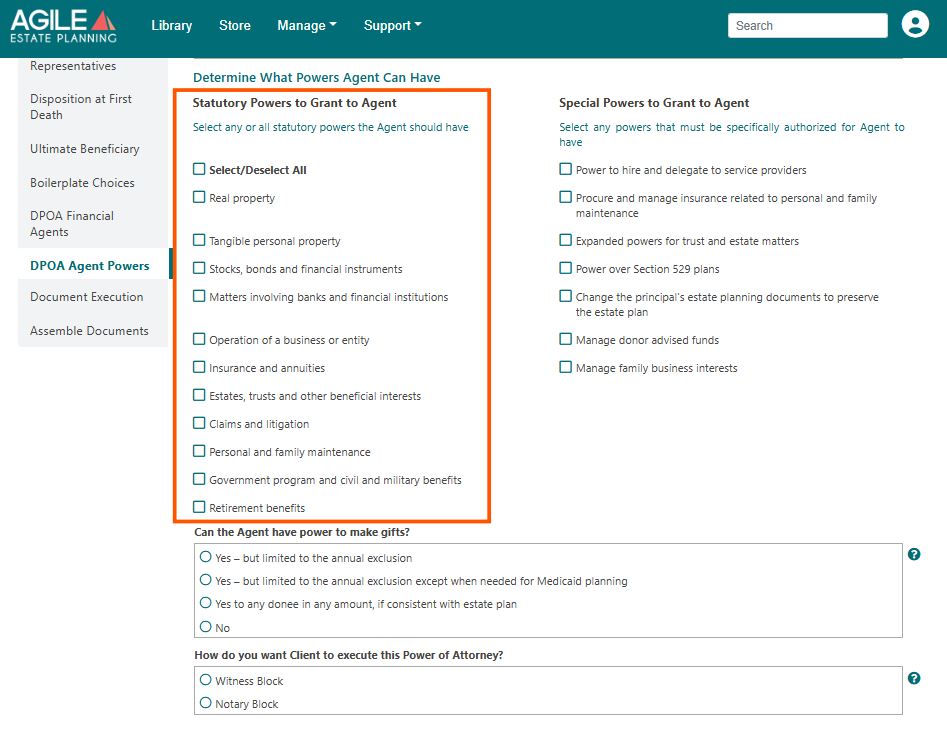
- Statutory Powers
- Special Powers requiring express authorization
You include authority for a client’s agent by checking the boxes next to the powers you want included in the document. Only the powers selected will appear in the final Durable General Power of Attorney.
Statutory Powers under RCW Chapter 11.125
The statutory powers listed in this tab correspond to the categories of authority set forth in Chapter 11.125 RCW. If a statutory category is checked, the resulting document will include both a general grant of authority and a specific reference to the selected statutory powers by subject matter with citations. This structure follows RCW 11.125.250 and related provisions.
Special Powers For Agents
This section of the tab contains powers that require express authorization under RCW 11.125.140 and RCW 11.125.240, as well as provisions that expand or clarify certain statutory powers available to an agent. Some of these powers correspond to the statutory “hot powers” that must be specifically granted under Washington law. Others supplement or modify statutory authority to address common estate planning situations or administrative needs that may not be fully addressed by the statute alone.
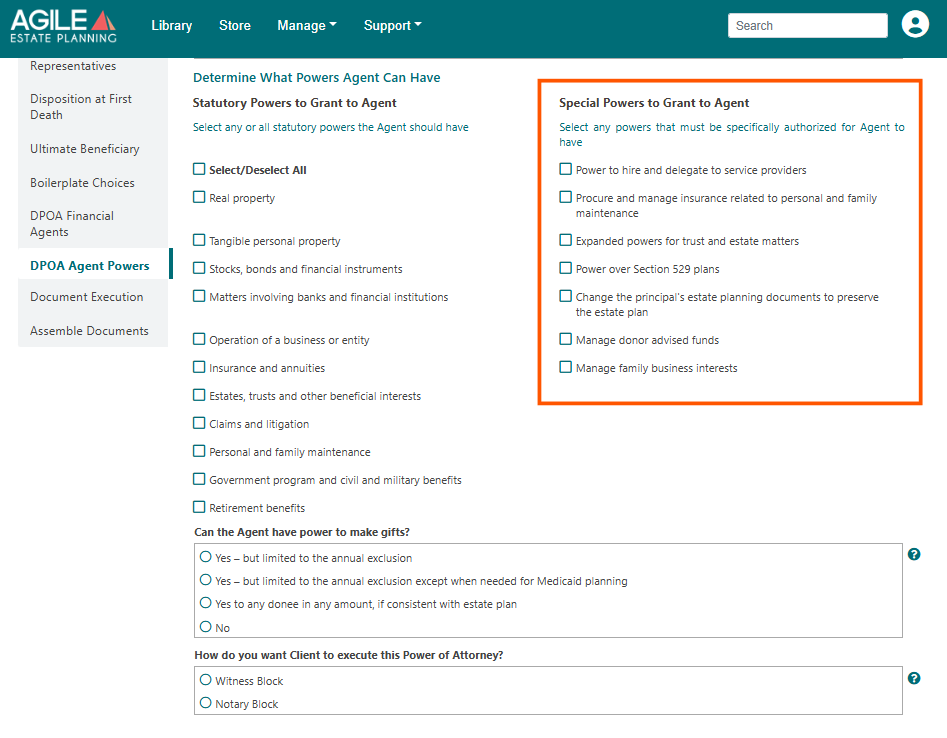
None of these provisions are included in the Durable General Power of Attorney unless you affirmatively select the corresponding option in the tab.
Power to Hire and Delegate to Service Providers
If selected, the Agent is authorized to hire professionals (such as attorneys, accountants, bookkeepers, property managers, and similar service providers) to assist in managing the principal’s affairs. This provision is intended to operate consistently with, and where appropriate clarify or supplement, the standards described in RCW 11.125.140(8).
Procure and Manage Insurance Related to Personal and Family Maintenance
If selected, the Agent is authorized to maintain existing insurance policies and obtain new coverage for the benefit of the principal and the principal’s family, including specifically adding unmarried partners to the definition of “family.” This provision supplements the statutory authority described in RCW 11.125.320 and RCW 11.125.350.
This authority includes the ability to manage health insurance, long-term care insurance, liability coverage, and asset protection policies. The Agent may coordinate with a health care agent to ensure that insurance coverage aligns with medical decisions and related claims. The Agent is not liable for making payments at the direction of the health care agent.
Expanded Powers for Trust and Estate Matters
If selected, this provision expands the Agent’s authority in connection with trusts, beneficiary interests, and related estate planning structures. While RCW 11.125.330 provides baseline authority for an agent to act with respect to estates, trusts, and other beneficial interests, the Agile EP provision clarifies and extends that authority in several areas commonly encountered in estate planning practice.
These enhancements include:
- Transfers to Additional Types of Trusts and Entities
The Agent may transfer assets into certain trusts that may not clearly fall within the statutory language, including joint revocable trusts, self-settled irrevocable trusts benefiting the principal, and transfers of out-of-state property into or out of trusts or entities to simplify administration or reduce ancillary probate exposure. - Exercise of Grantor-Retained Powers
If a trust instrument permits it, the Agent may exercise or release powers the principal holds as grantor, such as power to substitute assets. The provision does not create new powers but allows the Agent to act where the governing trust instrument authorizes action under a power of attorney. - Beneficiary Rights Under the Washington Uniform Trust Code
The Agent may exercise rights commonly available to beneficiaries under Chapter 11.98 RCW, including requesting information from trustees, objecting to fiduciary actions, and participating in trust administration to protect the principal’s interests. - Coordination Between Gifting Powers and Revocable Trust Assets
If gifting authority is granted, the Agent may withdraw assets from the principal’s revocable trust or direct the trustee to make distributions so that authorized gifts can be completed, even when the trustee and the agent are different individuals.
All actions taken under this authority remain subject to the fiduciary duties and statutory standards imposed by Chapter 11.125 RCW.
Power Over Section 529 Plans
If selected, the Agent may exercise all rights related to Section 529 education savings plans owned by the principal. This includes the authority to:
- Make withdrawals
- Change beneficiaries
- Modify account ownership
- Exercise any other rights held by the account owner
This provision is intended to clarify that the Agent may act with respect to 529 plans whenever the principal is the account owner, even if the account is maintained for the benefit of another person (such as a child or grandchild).
Change the Principal’s Estate Planning Documents to Preserve the Estate Plan
This provision grants authority that Washington law treats as a “hot power.” Under RCW 11.125.240, an Agent may exercise certain powers affecting the principal’s estate plan only if the power of attorney expressly authorizes it.
If selected, the Agent may take actions necessary to preserve the principal’s estate plan when circumstances change.
These actions may include:
- Creating, amending, or revoking trusts or community property agreements
- Modifying beneficiary designations or rights of survivorship
- Making nonprobate transfers at death
- Exercising powers of appointment
- Making gifts (if authorized)
These authorities are granted for a specific purpose: allowing the Agent to preserve the principal’s estate plan when circumstances may require action during incapacity.
Under RCW 11.125.140(1)(f), an Agent exercising these powers must attempt to preserve the principal’s estate plan, to the extent it is actually known to the Agent, if doing so is consistent with the principal’s best interests. In evaluating whether action is appropriate, the Agent must consider all relevant factors, including:
- The value and nature of the principal’s property
- The principal’s foreseeable obligations and need for maintenance
- Minimization of taxes, including income, estate, inheritance, generation-skipping transfer, and gift taxes
- The principal’s eligibility for government benefits or assistance programs
This provision ensures that the Agent has sufficient authority to respond to tax issues, asset titling problems, or other changes that could otherwise disrupt the client’s intended estate plan, while still remaining subject to the fiduciary standards imposed by Chapter 11.125 RCW.
Manage Donor Advised Funds
Donor-advised funds (DAFs) present a unique issue in estate planning because, once assets are contributed, they are legally owned by the sponsoring charitable organization, even though the donor retains advisory privileges regarding distributions and investments.
As a result, the donor’s authority is often governed primarily by the account agreement with the sponsoring institution, not by general financial powers under a power of attorney. Without express authority in the document, an Agent may face resistance from the sponsoring organization when attempting to act on the donor’s behalf.
If selected, this provision authorizes the Agent to exercise all rights the principal holds as the donor or account advisor of a donor-advised fund, including:
- Directing charitable distributions
- Providing investment recommendations where permitted
- Appointing successor account advisors
- Taking other actions permitted under the governing account agreement
Manage Family Business Interests
Closely-held businesses often depend on the active involvement of their owners. Washington law provides baseline authority for an Agent to manage business interests under RCW 11.125.310, but additional clarification is often helpful in practice.
Agile EP’s Power of Attorney incorporates and grants these statutory business powers and also grants the parallel trustee authorities described in RCW 11.98.070(21) to strengthen the Agent’s ability to manage the principal’s business interests. If selected, this provision authorizes the Agent to exercise the principal’s ownership rights in closely-held businesses and participate in management decisions where permitted by governing agreements.
The document also addresses situations where the principal serves as an officer, director, manager, or similar fiduciary. The Agent may succeed to that role only if the governing documents permit it and the Agent agrees in writing, and the Agent may also resign from the role on the principal’s behalf. This authority is limited to closely-held businesses and does not extend to unrelated fiduciary positions.
Finally, the provision anticipates situations where the Agent is already involved in the same business. A conflict-of-interest waiver allows the Agent to act despite that overlap and receive reasonable compensation, provided the Agent acts in good faith and consistent with the fiduciary duties in Chapter 11.125 RCW.
Gifting Powers
Gifting authority is treated as a statutory “hot power.” Under RCW 11.125.240(1), an Agent may make gifts on behalf of the principal only if the Power of Attorney expressly authorizes that authority. If gifting authority is granted, RCW 11.125.390 provides the default rules governing the scope of those gifts, generally limiting them to the federal annual gift tax exclusion unless the Power of Attorney modifies that limit. Even when broader gifting authority is authorized, the Agent must still comply with the fiduciary standards in RCW 11.125.140, including the obligation to attempt to preserve the principal’s estate plan when it is known and consistent with the principal’s best interests.
You must select one gifting option, which will determine the scope of the Agent’s authority.
Gifts Limited to the Annual Exclusion
If selected, the Agent may make gifts consistent with RCW 11.125.390. The document incorporates the standard set forth in RCW 11.125.390(3), including gifts to individuals, entities, and custodial accounts on behalf of a gift recipient. The authority is limited to the applicable federal annual exclusion amount.
Gifts Limited to the Annual Exclusion Except When Needed for Medicaid Planning
If selected, the Agent’s authority generally follows the statutory limits in RCW 11.125.390 and RCW 11.125.240(3), but the Agent may exceed the annual exclusion amount when reasonably necessary for Medicaid or long-term care planning.
The document incorporates the standards described in RCW 11.125.390(3), including the ability to make gifts for this purpose to individuals, entities, and custodial accounts.
Gifts to Any Donee in Any Amount, If Consistent with the Estate Plan
This option grants the broadest gifting authority.
If selected, the Agent may make gifts to any donee in any amount, provided the gifts are consistent with the principal’s estate plan, known gifting practices, or intended distribution plan. This allows the Agent to continue an established gifting strategy or take actions necessary to preserve the principal’s estate planning objectives.
All gifting authority remains subject to the fiduciary duties imposed by Chapter 11.125 RCW, including the obligation to act in good faith and in the principal’s best interests.
Powers Included Automatically In the DPOA
Certain provisions are always included in the Durable General Power of Attorney and do not appear as selectable options in the interview. These provisions are part of the standard Agile EP form and are included in the final document regardless of which statutory or special powers are selected.
Digital Asset Authority
The Agent is granted broad authority over the principal’s digital assets and electronic communications. This includes the ability to access, manage, transfer, and control digital accounts and content; recover or reset passwords; decrypt electronically stored information; and coordinate with custodians or trustees regarding digital property.
This authority is drafted to comply with applicable federal and state privacy and digital access laws, including laws governing access to electronic communications and digital property.
Restrictions Over Foreign Assets
The Agent is not granted authority over certain foreign financial assets unless the Agent affirmatively assumes that authority in writing.
This limitation applies to assets such as passive foreign investment companies and foreign financial accounts. The provision is designed to prevent the Agent from inadvertently becoming subject to complex reporting obligations under federal law, including FBAR (Foreign Bank Account Report) requirements and related penalties.
Limitations on Self-Dealing and Gifts to the Agent
The document places limits on an Agent’s ability to make gifts to themselves or confer personal benefits.
Unless otherwise permitted for the Agent’s health, education, support, or maintenance, the Agent may not transfer assets to themselves without additional review. If a transfer to the Agent is otherwise authorized, a co-agent must review and approve the action.
This structure helps reduce potential conflicts of interest and avoids unintended tax consequences, such as the creation of a general power of appointment.