

The Disposition of the Remaining Estate (Percentage Shares) tab controls how the residuary estate is divided into defined percentage or fractional shares and distributed. For married couples, this tab governs second-death planning. For unmarried couples who elect coordinated planning, this tab similarly governs distribution after the death of the second partner.
This tab performs three primary functions:
- It establishes the number and size of residuary shares (expressed as percentages or fractions)
- It names the beneficiary or beneficiaries for each share, including any contingent beneficiaries
- It determines, for each share, whether distribution is made outright or in trust and defines the structure of that distribution
When This Tab Appears
The Disposition of Remaining Estate (Percentage Shares) tab appears when “type of residuary devise” is set to Percentage or Fractional Shares on the Document Planning tab.
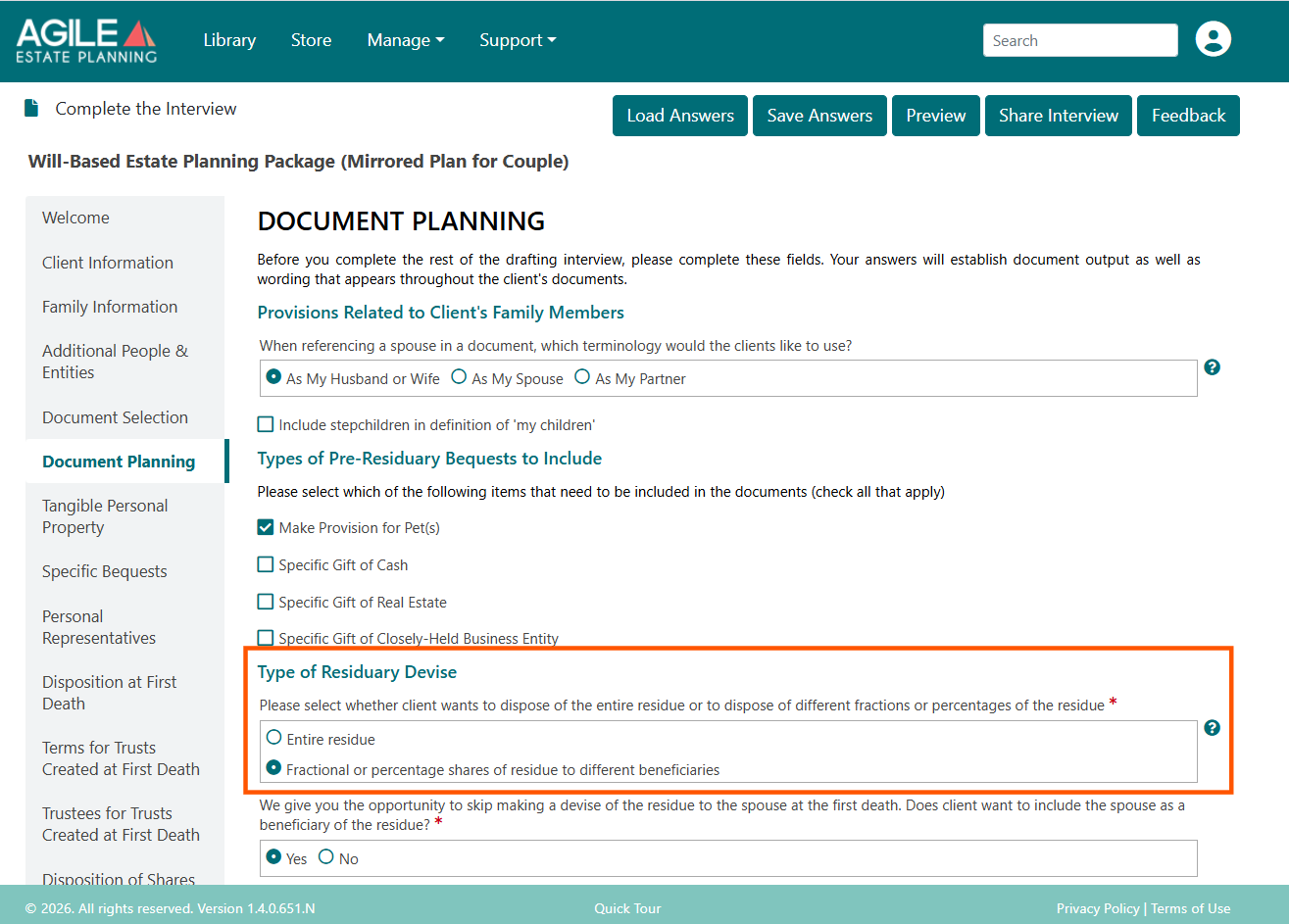
Unlike the Entire Residue structure, which applies one distribution framework to the whole residue, this structure allows each portion of the residue to operate independently. If you want to draft a devise of the entire residue, see this article.
This tab controls second-death planning for married couples and unmarried couples (if elected), and death-of-the-client planning in single-client matters.
How “Residue” Is Defined
For purposes of this structure, the residue consists of the property remaining after payment of debts, expenses of administration, and estate taxes under the default drafting provisions. However, because the percentage share of the residue can include charitable beneficiaries, the default tax provision allocates payment of estate taxes (but not expenses) away from a charitable share. A detailed explanation of the default tax and expense provisions is provided in this article.
How the Percentage Share Structure Works
Under this approach, the residue is divided into separate shares expressed as percentages or fractions. Each share is then assigned its own:
- Beneficiary structure
- Distribution type (outright or in trust)
- Contingent planning
Each share is drafted independently, but all shares together must total 100 percent (or one whole).
For example, a plan might allocate:
- 50% to a spouse in trust
- 25% to a child outright
- 25% to a charitable organization
Each share would be configured separately on this tab.
If a share lapses and no alternate beneficiary structure applies, that share is redistributed proportionately among the remaining shares according to their stated percentages.
Adding and Allocating Shares
The drafter first determines how many shares will be created. To create a share, select “Add Share Information…”. Each share opens as a separate configuration page.
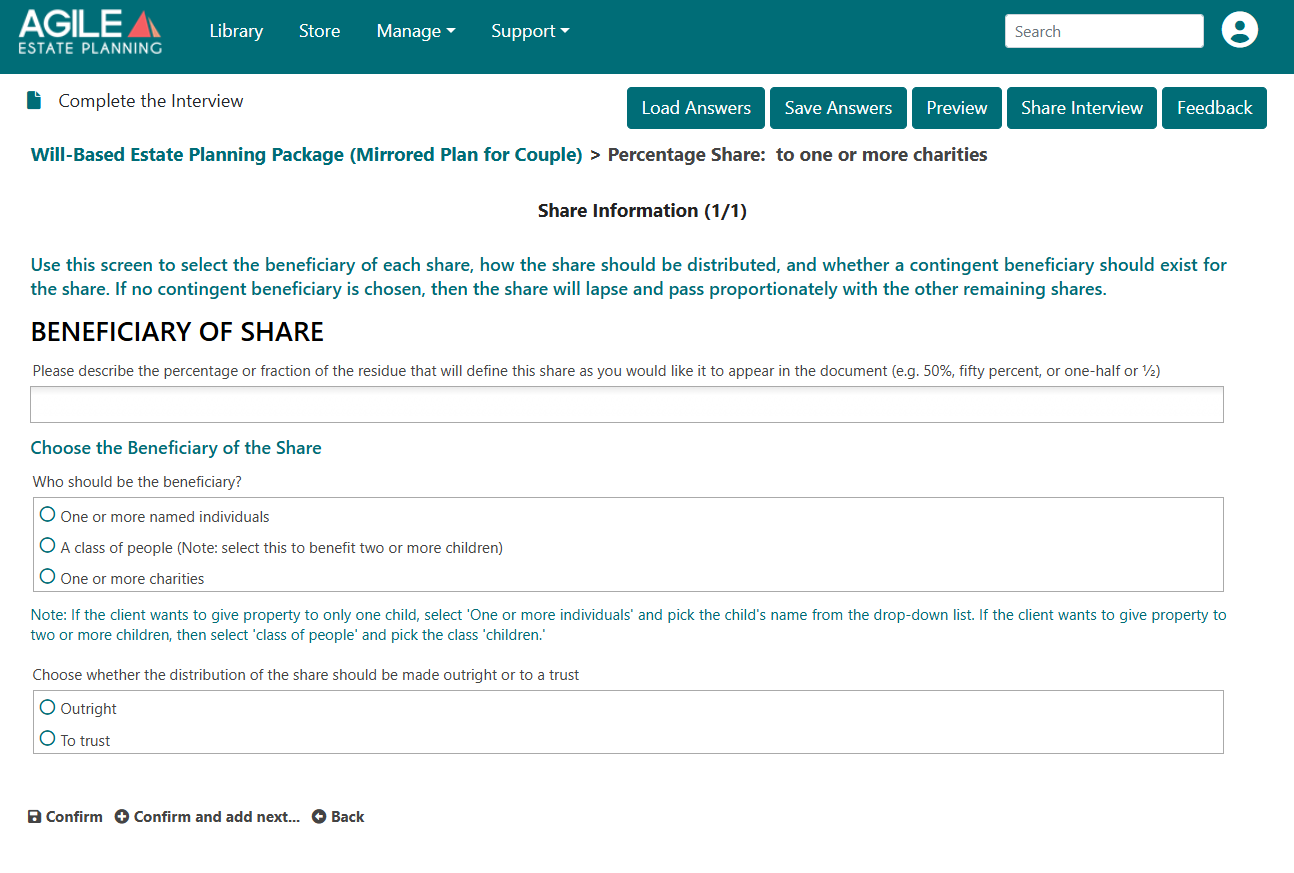
On the share’s individual screen, the drafter enters:
- The percentage or fraction that defines the share
- The beneficiary structure for that share
- Whether the share is distributed outright or in trust
- Whether a contingent beneficiary should be named
After completing a share, it appears as a separate line item on the main tab. Additional shares are added in the same manner. All shares together must total 100 percent (or one whole). The document reflects the combined effect of all configured shares.
Beneficiary Selection Per Share
Each share of the residue must be assigned to a beneficiary structure. The residue may be distributed, on a share-by-share basis, as follows:
One or More Named Individuals
If individuals are named directly, the document includes the names of those individuals and allocates the stated percentage or fractional share among them. If more than one individual is selected for a share, the document distributes that share among them as provided in the selection for that share.
A Class of People
When a class is selected, the drafter must determine how shares are calculated among class members. Two common structures are available:
- Per capita, which creates shares only for living members of the class at the applicable distribution date.
- By representation, which creates shares for living members and for deceased members with surviving descendants, allocating by branch as defined in the governing statute.
This selection interacts directly with the Family Information tab and descendant entries. If a class is selected, earlier parentage designations, descendant entries, and deceased family member entries determine who will be included as members of that class at the time of distribution.
One or More Charitable Organizations
If charitable organizations are selected, the document includes the names of those organizations, defines them as qualified charities, and allocates the stated percentage or fractional share of the residue accordingly.
Special Needs Trust Share
When the plan includes a Special Needs Trust, a share for one named individual asks “Should this share be held in a Special Needs Trust for its beneficiary?” Answering Yes sends the share to the Trustee of a Special Needs Trust and shows that trust’s name, terms and Trustees in the share. Only one share in a plan can be held in a Special Needs Trust. A Special Needs Trust share can have only one beneficiary; if a second person is added, an Action Needed message appears.
See this article for the trust’s name, terms and Trustees, and this article for every step that sets up a Special Needs Trust.
Outright Distribution or Distribution in Trust (Per Share)
For each share, the drafter must determine whether distribution is made outright or in trust.
Outright Distribution
If a share is distributed outright, the drafter must determine whether any age-based or custodial conditions apply. Available options include:
- Outright without condition
- Outright, but if under age 25, to a UTMA account
- Outright, but if under a selected age, to a contingent trust
These options allow individual shares to incorporate age protection without converting the entire residuary plan into a long-term trust structure.
Distribution in Trust
If a share is distributed in trust, the drafter selects one of the three trust structures:
- Trust that distributes at specified age(s)
- Lifetime Trust (Non-Dynasty)
- Lifetime Dynasty Trust
The detailed administrative and distribution terms for any trust created under a share are configured on the Terms for Trusts Created for Residuary Beneficiaries tab, which is discussed in this article.
Lapsed Shares Are Redistributed Proportionately
If a residuary share has no living beneficiaries to take under its terms, that share does not fail. Instead, it is redistributed proportionately among the remaining shares.
This means that if one beneficiary’s share of the residue lapses, the lapsed share is reallocated to the remaining beneficiaries in a manner that preserves the original ratios between their shares.
In other words, the relative proportions among the remaining beneficiaries remain the same.
Example
Assume the residue is divided as follows:
- A receives 50%
- B receives 30%
- C receives 20%
If C’s 20% share lapses, A and B must share the full 100% of the residue. Their original shares (50% and 30%) reflect a ratio of 5:3.
Because the redistribution preserves that ratio:
- A receives 62.5%
- B receives 37.5%
The 20% lapsed share is therefore divided proportionately between A and B so that their relative 5:3 relationship remains intact.
How the Calculation Works
A and B together originally held 80% of the residue (50% + 30%).
Their proportional interests in that 80% are:
- A: 50 ÷ 80 = 5/8
- B: 30 ÷ 80 = 3/8
C’s 20% share is then allocated according to those proportions:
- A receives 5/8 of 20% (12.5%)
- B receives 3/8 of 20% (7.5%)
Those amounts are added to their original shares:
- A: 50% + 12.5% = 62.5%
- B: 30% + 7.5% = 37.5%
This preserves the original proportional balance between A and B.