

The Disposition of Remaining Estate tab controls how the residuary estate is distributed. For married couples, this tab controls second-death planning. For unmarried couples who elect coordinated planning, this tab similarly governs distribution after the death of the second partner.
This tab performs three primary functions:
- It names the primary residuary beneficiary or beneficiaries
- It names the contingent residuary beneficiary or beneficiaries
- It determines whether distribution is made outright or in trust, and defines the structure of that distribution
When This Tab Appears
This tab appears when the type of residuary devise selected on the Document Planning tab is Entire Residue.
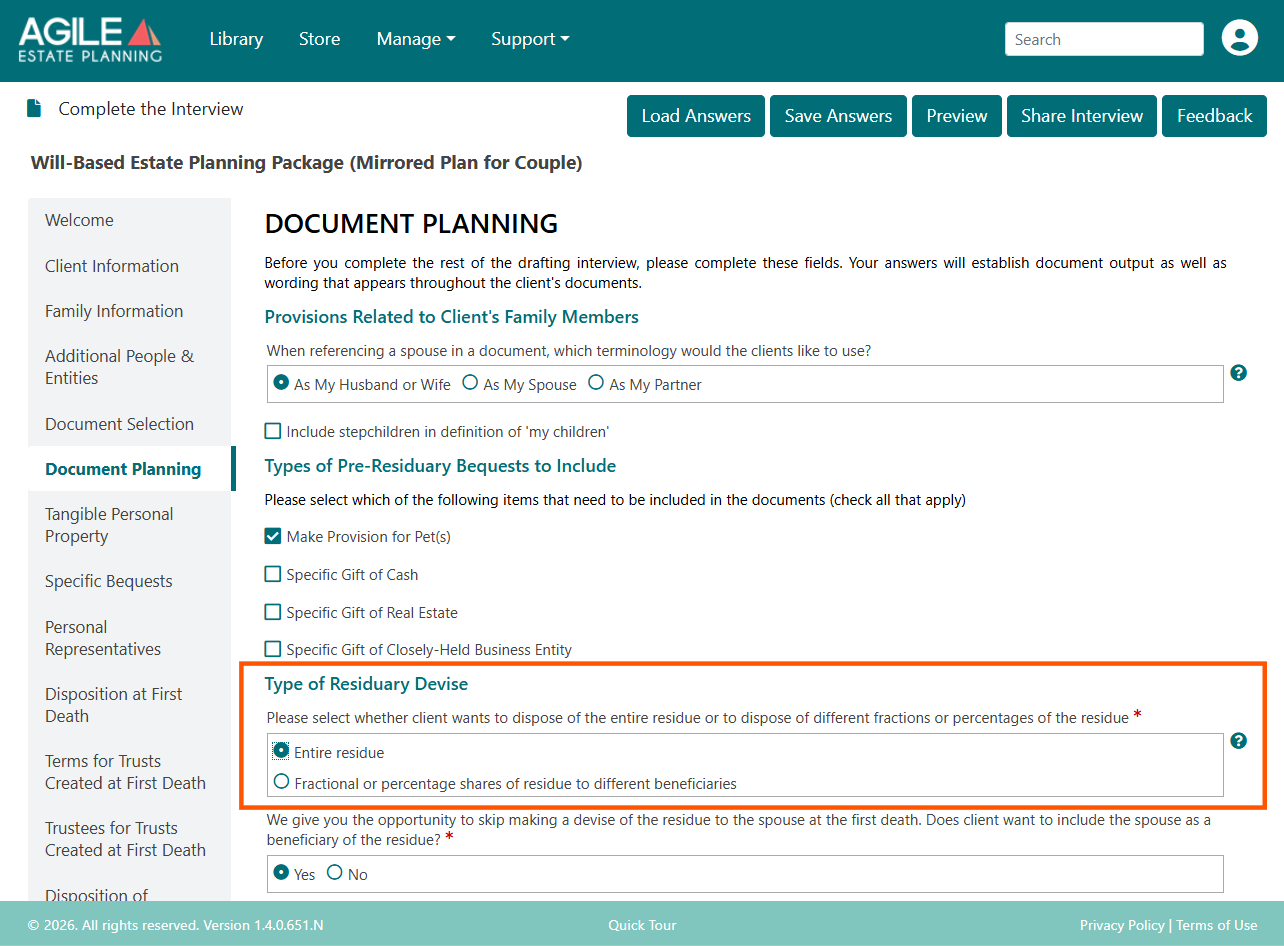
Under this structure, the residue is treated as a single pool and distributed according to the beneficiary, trust, and allocation selections made here. If you want to draft a percentage or fractional share devise of the residue, see this article.
How “Residue” Is Defined
For purposes of this structure, the residue consists of the property remaining after payment of debts, expenses of administration, and estate taxes under the default drafting provisions. A detailed explanation of the default tax and expense provisions is provided in this article.
Beneficiary Selection
The residue may be distributed to one of the following beneficiary types.
One or More Named Individuals
If individuals are named directly, the document includes the names of those individuals and gives each individual an equal share of the residue. The number of shares are calculated at the applicable distribution event (for example, second death in coordinated plans).
A Class of People
When a class is selected, the drafter must also determine how shares are calculated among class members. Two common structures are available:
- Per capita, which creates shares only for living members of the class at the date of the testator or Trustor’s death.
- By representation, which creates shares for living members and for deceased members with surviving descendants, allocating by branch, all as defined by RCW 11.02.005(17).
If a class is selected, earlier parentage designations, descendant entries, and deceased family members entries in the Family Information tab determine the beneficiaries who will be class members at the time of distribution.
If the class selected is “children,” additional structural trust decisions may be required, including pooled versus separate trusts and share design, discussed below.
One or More Charitable Organizations
If charities are named directly, the document includes the names of those organizations, defines them in the document as “qualified charities” and gives them equal shares of the residue.
Special Needs Trust Beneficiary
When the plan includes a Special Needs Trust, the beneficiary whose share is held in it is selected in the Special Needs Trust Beneficiary section of this tab, and only one can be selected. That share passes to the Trustee of the Special Needs Trust instead of to the beneficiary. The outright or trust question then governs the shares of the other residuary beneficiaries only.
The trust’s name, terms and Trustees are set on the Special Needs Trust Terms and Trustees tab; see this article for that tab. See this article for every step that sets up a Special Needs Trust.
Outright Distribution or Distribution in Trust
If individuals or a class are selected as residuary beneficiaries, the drafter must determine whether distribution is made outright or in trust.
Outright Distribution
If distribution is selected as outright, beneficiaries receive their shares directly at the applicable distribution date, subject to any conditions selected on this tab. When distributing outright, the drafter must also determine whether any age-based or custodial conditions apply.
The available options include:
- Outright without any condition
The beneficiary receives their share immediately and without restriction at the time of distribution. - Outright, but if the beneficiary is under 25, to a UTMA account
If the beneficiary has not yet reached age 25 at the time of distribution, the share is transferred to a custodian under the Uniform Transfers to Minors Act. The custodian holds the property until the statutory age of termination. - Outright, but if the beneficiary is under a chosen age, to a Contingent Trust
If the beneficiary has not reached the selected age, the share is distributed to a contingent trust rather than directly to the beneficiary. The age of termination for that contingent trust is selected on the Contingent Trust tab.
These options allow the drafter to preserve an outright distribution structure while addressing minor or young beneficiaries without converting the entire residuary plan into a long-term trust design.
Distribution in Trust
If distribution is made in trust, this tab determines the structural type of trust that will be created for each residuary beneficiary. Detailed administrative terms are selected on later trust-related tabs.
Three trust structures are available:
- Age Certain Trust
A trust that distributes at a specified age (or ages). If the “age certain” trust is selected, the number of mandatory distributions (one, two, or three stages) is selected on this tab, and the ages for distribution are entered directly on this screen. The final age selected controls termination of the trust. - Lifetime Trust
A lifetime trust for the Primary Beneficiary that distributes outright at the next generation. - Dynasty Trust
A lifetime trust for the Primary Beneficiary that may continue for successive generations as a dynasty structure under the Washington Rule Against Perpetuities.
If you would like to review the drafting options available for these three types of trusts, see this article.
Pot Trust Option for Children
If the selected residuary class is children and distribution is made in trust, an additional structural decision is required before selecting the trust type. The drafter must determine whether the children’s shares will be administered collectively or separately from the outset.
- Create a Pot Trust
Under a pot trust structure, a single trust is created for all children, and assets are administered together until division occurs at the specified age of the youngest child. - Create Separate Trusts Immediately
Under a separate trust structure, each child’s share is established immediately and administered independently.
Once the pooled or separate structure is selected, the drafter then chooses one of the three trust types described above, which governs how each trust operates.