

When the surviving spouse is not a U.S. citizen, the unlimited federal marital deduction is not automatically available. To qualify for the marital deduction, assets must pass to a Qualified Domestic Trust (QDOT) that complies with federal requirements and, in Washington, separate state-level QDOT provisions.
The Disposition at First Death tab includes modified funding formulas specifically for noncitizen spouse planning. These formulas conditionally direct assets to a Domestic Marital Trust (QDOT) if the surviving spouse is not a U.S. citizen at the time of the first death. This article addresses only the funding mechanics. It does not replace the need for separate tax analysis when drafting for a noncitizen spouse.
Formula options if both clients are citizens:
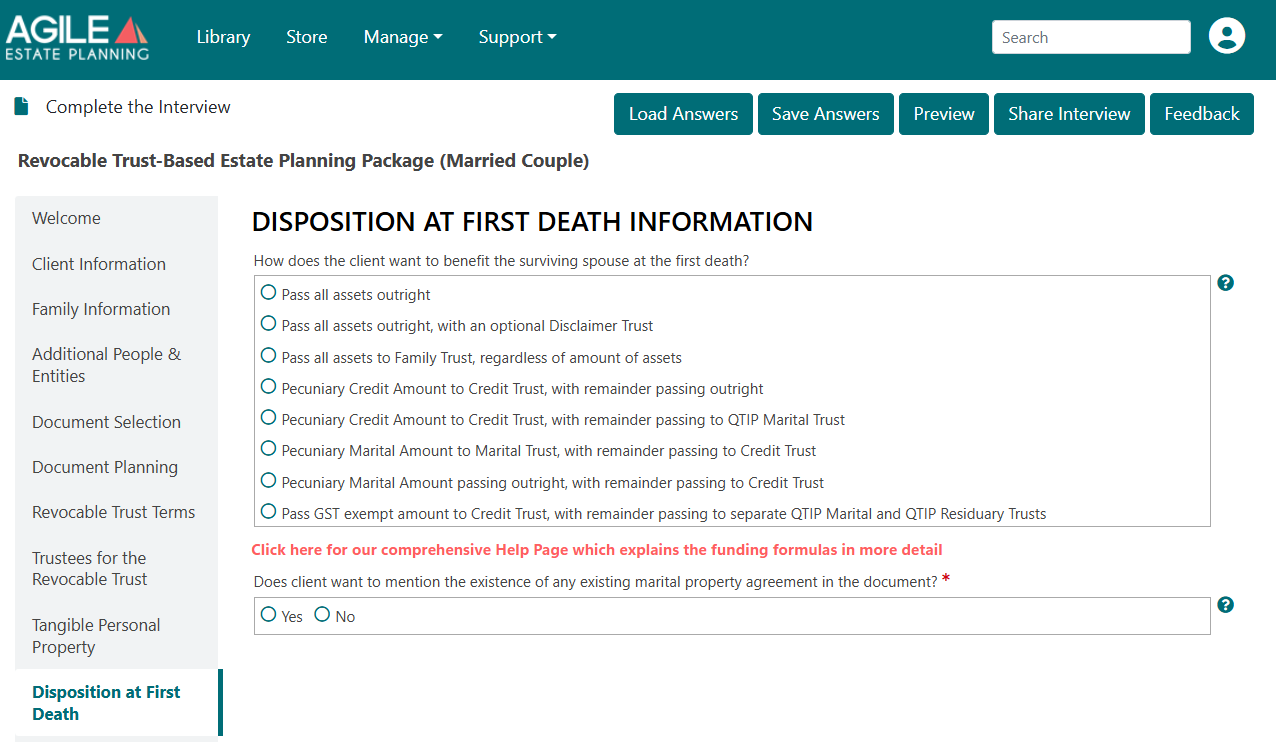
Fewer formula options if a client is a noncitizen:
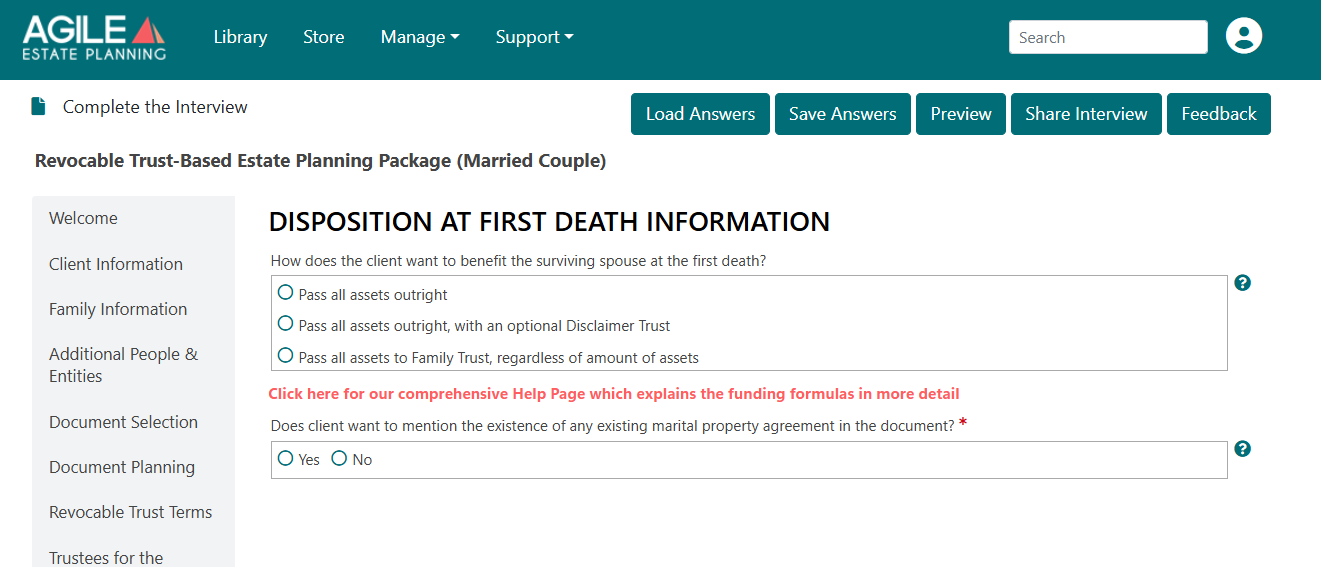
QDOT planning is only available in certain package types and is not supported in Mirrored Planning packages. Mirrored planning assumes that both spouses are subject to the same marital deduction framework, which does not allow for the structural differences required when one spouse is not a U.S. citizen.
If QDOT planning is needed, you must use a Joint Revocable Trust package or an appropriate Separate Trust or Will-based package that can accommodate the required structure.
Joint Revocable Trust QDOT Plans
In the Joint Revocable Trust versions of the noncitizen spouse formulas, the distribution at the first death is conditional based on the surviving spouse’s citizenship status at that time. Under these joint trust formulas:
- If the surviving spouse is a U.S. citizen at the time of the first death assets pass according to the standard (non-QDOT) structure selected — such as into the Survivor’s Trust, Credit Trust or Family Trust.
- If the surviving spouse is not a U.S. citizen at the time of the first death assets pass instead to a Domestic Marital Trust (QDOT) in order to qualify for the marital deduction.
The citizenship determination is made as of the first spouse’s death when it will be known which spouse (the citizen or non-citizen) is the "Survivor."
Separate Revocable Trust and Will-Based QDOT Plans
In Separate Revocable Trust and Will-based noncitizen spouse versions, the structure is not conditional in the same manner. In these plan types, the QDOT provisions are embedded directly in the funding structure rather than functioning solely as a conditional overlay because the non-citizen spouse's identity is known.
Available QDOT-Based Formulas
These options determine how assets are distributed at the first spouse’s death. The selected formula applies whether the plan uses a Joint Revocable Trust, Separate Revocable Trusts, or a Will-based plan.
When the surviving spouse is not a U.S. citizen, assets that would normally qualify for the marital deduction must instead pass to a Qualified Domestic Trust (QDOT) in order to preserve the marital deduction.
Pass All Assets to Surviving Spouse (or Survivor’s Trust)
This option directs all assets to the surviving spouse at the first death. The mechanics differ depending on the structure of the plan.
Joint Revocable Trust Plans
If the surviving spouse is a U.S. citizen, all assets pass to the Survivor’s Trust.
If the surviving spouse is not a U.S. citizen at the first death, the assets instead pass to the Domestic Marital Trust (QDOT).
In a joint trust structure, citizenship determines whether the Survivor’s Trust or the Domestic Marital Trust is funded.
Separate Revocable Trust or Will-Based Plans
Assets are initially directed outright to the surviving spouse. However, if the surviving spouse is not a U.S. citizen, the documents allow the spouse to disclaim assets as a fallback. Any disclaimed property passes to the Domestic Marital Trust (QDOT) instead.
Pass All Assets to Surviving Spouse With Optional Disclaimer Trust
This option directs all assets to the surviving spouse at the first death but allows the surviving spouse to disclaim some or all of the inheritance.
Joint Revocable Trust Plans
Assets initially pass to the Survivor’s Trust.
If the surviving spouse disclaims assets and is a U.S. citizen, the disclaimed assets pass to a Disclaimer Trust.
If the surviving spouse disclaims assets and is not a U.S. citizen, the disclaimed assets pass to a Domestic Marital Trust (QDOT).
Assets that are not disclaimed remain in the Survivor’s Trust.
Separate Revocable Trust or Will-Based Plans
Assets are initially directed outright to the surviving spouse. If the spouse disclaims assets and is not a U.S. citizen, the disclaimed assets pass to a Domestic Marital Trust (QDOT). In this structure, QDOT funding replaces the standard Disclaimer Trust when the surviving spouse is a non-citizen.
Pass All Assets to Family Trust, Regardless of Amount
This option directs all assets into a trust at the first death, rather than passing assets outright to the surviving spouse.
Joint Revocable Trust Plans
If the surviving spouse is a U.S. citizen, assets pass to the Family Trust.
If the surviving spouse is not a U.S. citizen, assets pass to the Domestic Marital Trust (QDOT).
Separate Revocable Trust or Will-Based Plans
Assets pass directly into the Domestic Marital Trust (QDOT) at the first death for the benefit of the non-citizen spouse. Under this option, no assets pass outright to the surviving spouse.
Document Changes Triggered by Selecting QDOT Planning
When a QDOT-related formula is selected, the system automatically inserts and modifies several provisions in the document to ensure the plan can qualify for the marital deduction when the surviving spouse is not a U.S. citizen. These changes ensure compliance with Internal Revenue Code §2056A and applicable Washington QDOT rules.
Domestic Marital Trust (QDOT) Article
A dedicated Domestic Marital Trust (QDOT) article is added to the document. This article:
Establishes the Domestic Marital Trust
Names the noncitizen spouse as the primary beneficiary
States the intent for the trust to qualify as a QDOT
Allows the Personal Representative to elect QDOT treatment
Permits the trustee to accept additional assets transferred to the trust to qualify for the marital deduction (to plan for post-death assignments that might be needed)
The article also allows the trust terms to be amended if necessary to ensure QDOT qualification.
QDOT Compliance Provisions
Additional provisions are inserted to ensure the Domestic Marital Trust can qualify as a Qualified Domestic Trust (QDOT) under federal law (IRC §2056A) and, when applicable, Washington law (RCW 83.100.047).
These provisions address:
Restrictions on distributions of principal
Authority for the trustee to withhold and pay estate taxes
Requirements that certain distributions be approved by a U.S. Trustee
Rules governing taxable distributions from the QDOT
Coordination of federal and Washington estate tax obligations
These provisions ensure that estate tax can be collected when principal is distributed or when the surviving spouse dies, as required by both federal and Washington QDOT rules.
Trustee Eligibility Requirements
The document also inserts provisions governing QDOT trustee eligibility, consistent with both federal regulations and Washington law. These provisions require:
At least one U.S. Trustee while the trust qualifies as a QDOT.
Compliance with security or institutional trustee requirements depending on the value of the trust assets.
For Washington QDOTs, an additional requirement applies, including a trustee who is a U.S. citizen resident of Washington, or a Washington corporation or a bank authorized to transact business in Washington.
Tax Withholding and Payment Provisions
Additional administrative language is inserted to address estate tax obligations associated with QDOTs, including:
Authority for the trustee to withhold estate tax from distributions
Procedures for paying estate tax triggered by taxable distributions
Coordination between the Personal Representative and trustee for tax reporting and payment.
QTIP-Style Structure of the Domestic Marital Trust
Although the trust is labeled a Domestic Marital Trust (QDOT), its substantive provisions are drafted to function like a QTIP marital trust. The trust terms therefore include the key features required for marital deduction treatment, including:
The surviving spouse is the primary beneficiary of the trust.
All net income must be distributed to the surviving spouse at least annually.
The trustee may distribute principal for the spouse’s health, education, maintenance, and support
The spouse may be granted a testamentary nongeneral power of appointment, depending on the selected options.
Remainder beneficiaries are determined by the first spouse’s plan, ensuring ultimate control of the disposition of the assets.
Because the trust is drafted with these QTIP-like provisions, the same trust structure can function as:
A standard marital/QTIP trust if the surviving spouse is a U.S. citizen, or
A Qualified Domestic Trust (QDOT) if the surviving spouse is not a U.S. citizen.
This approach allows the plan to preserve the marital deduction while maintaining the traditional marital trust structure, rather than funding a separate credit or bypass trust at the first death. This allows the attorney to flexibly plan to make disparate state or federal QDOT elections at the death of the first spouse when more is known about the family's circumstances.